If you’ve ever tried to get a straight answer on commercial cleaning pricing, you’ve probably experienced the runaround one quote comes in at $400/month, another at $1,800, and neither vendor explains why the difference exists. You’re left trying to reverse-engineer the logic while your facilities budget sits in limbo.
Here’s the number you came for: commercial cleaning typically costs between $0.05 and $0.25 per square foot, depending on facility type, service frequency, and scope. But that range only becomes useful once you understand what moves your number toward one end or the other.
This guide breaks down exactly how commercial cleaning cost per square foot is calculated, what factors drive pricing up or down, how different service types are priced, and how to evaluate quotes so you’re comparing apples to apples not apples to a completely different fruit. Whether you manage a 4,000 sq ft dental office or a 150,000 sq ft distribution facility in Colorado, this is your complete 2026 pricing reference.
What Is the Average Commercial Cleaning Cost Per Square Foot in 2026?
Let’s start with the numbers that matter.
For standard routine janitorial service the kind that covers vacuuming, trash removal, restroom sanitation, surface wiping, and break room maintenance most commercial facilities pay between $0.07 and $0.15 per square foot per visit. On a monthly basis, that translates to:
| Facility Size | Est. Monthly Cost (3x/week) | Est. Monthly Cost (5x/week) |
| 2,500 sq ft | $400?$750 | $600?$1,100 |
| 10,000 sq ft | $1,000?$1,800 | $1,500?$2,800 |
| 30,000 sq ft | $2,500?$4,500 | $4,000?$7,200 |
| 75,000 sq ft | $5,000?$9,500 | $8,500?$15,000 |
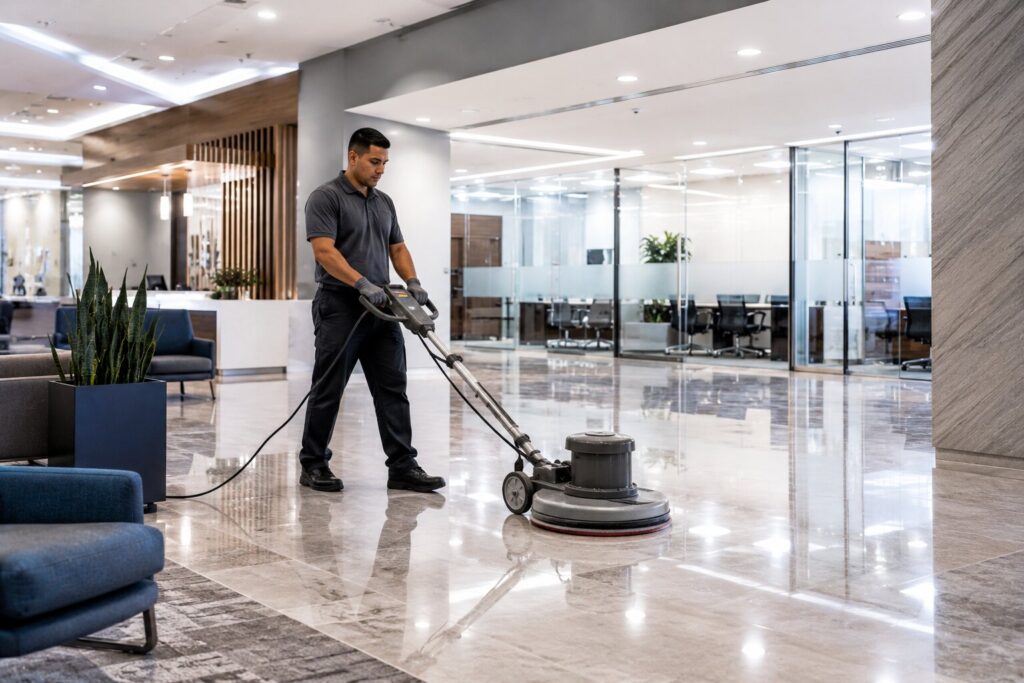
For periodic deep cleaning or specialty services like carpet extraction, hard floor refinishing, or exterior power washing, prices typically run $0.15?$0.40 per square foot and are usually quoted separately from routine janitorial contracts.
One important nuance: smaller spaces cost more per square foot, not less. A 2,000 sq ft suite doesn’t take proportionally less time than a 20,000 sq ft floor it just doesn’t benefit from economies of scale. Professional cleaning companies have minimum visit charges that apply regardless of size, so the per-square-foot math often works against small facility owners.
The 7 Factors That Determine Your Commercial Cleaning Price
Square footage tells the bidder how big the job is. These seven variables tell them how hard it will be.
-
Facility Type and Use
A corporate law office with light foot traffic and a strict no-food policy is about as easy to clean as commercial spaces get. A medical clinic with exam rooms, biohazard disposal requirements, and high-touch surface protocols is a fundamentally different job same square footage, dramatically different cost.
High-cost facility categories include:
- Medical and dental offices
- Food production and commercial kitchens
- Childcare and educational facilities
- Gyms and fitness centers
- High-traffic retail and hospitality
Lower-cost categories include:
- Professional offices with light daily traffic
- Tech or creative workspaces with minimal restrooms
- Warehouse and light industrial (open floor, minimal fixtures)
-
Cleaning Frequency
This is the factor most facility managers underestimate. Daily cleaning typically costs more per month but less per visit, because each visit involves a manageable amount of soil. Weekly or bi-weekly cleaning costs less per month but significantly more per visit because the work compounds.
Think of it this way: a conference room cleaned daily takes ten minutes. The same room ignored for two weeks takes forty-five.
-
Number and Type of Restrooms
Restrooms are the most labor-intensive part of any commercial cleaning scope. A building with one single-occupancy restroom is a completely different job than a multi-story facility with six multi-stall restrooms per floor. Industry estimates often suggest restroom servicing accounts for 30?45% of total janitorial labor time.
-
Floor Surface Types
Carpet, VCT tile, polished concrete, hardwood, luxury vinyl plank, and ceramic tile all require different equipment, products, and techniques. Facilities with a mix of surface types say, carpet in offices, tile in restrooms, and polished concrete in common areas require a crew equipped for all three. Carpet and floor reconditioning is almost always priced as a separate periodic service rather than folded into routine janitorial rates.
-
Building Layout and Accessibility
Open-plan floors clean efficiently. Maze-like cubicle configurations, narrow corridors, multi-story layouts without freight elevator access, and buildings without after-hours dock access all add time. Time is the primary driver of labor cost and labor is typically 60?70% of a cleaning contract.
-
Service Hours
Overnight or after-hours cleaning is the standard in most commercial facilities, and it’s generally more cost-effective because crews can work without navigating active workspaces. Daytime cleaning including day porter services, where staff are present during business hours for ongoing maintenance, restocking, and response commands a premium. It’s a premium worth paying for high-traffic lobbies, hospitality environments, and buildings where first impressions matter every hour of the day.
-
Special Requirements and Certifications
Green cleaning protocols, hospital-grade disinfection standards, LEED documentation requirements, security clearance access, and union labor requirements all affect pricing. If your lease or sustainability policy requires certified cleaning products, ask vendors about compliance with the EPA’s Safer Choice program, which certifies products that meet safety and environmental standards without sacrificing effectiveness.
Commercial Cleaning Pricing by Service Type
Not every facility service is priced per square foot. Understanding how different services are quoted helps you budget accurately and prevents surprise invoices.
Routine Janitorial (Priced Per Sq Ft or Per Visit)
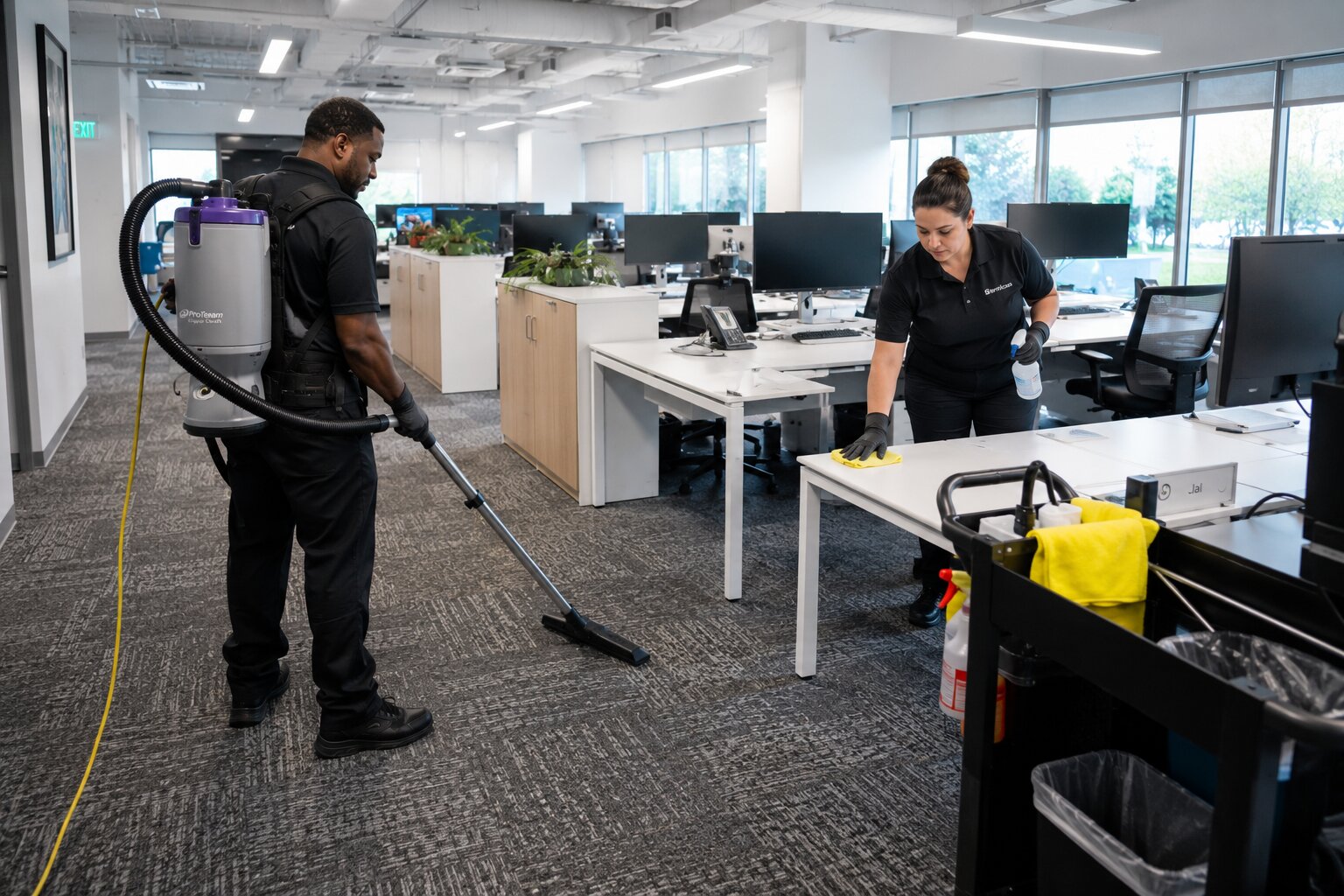
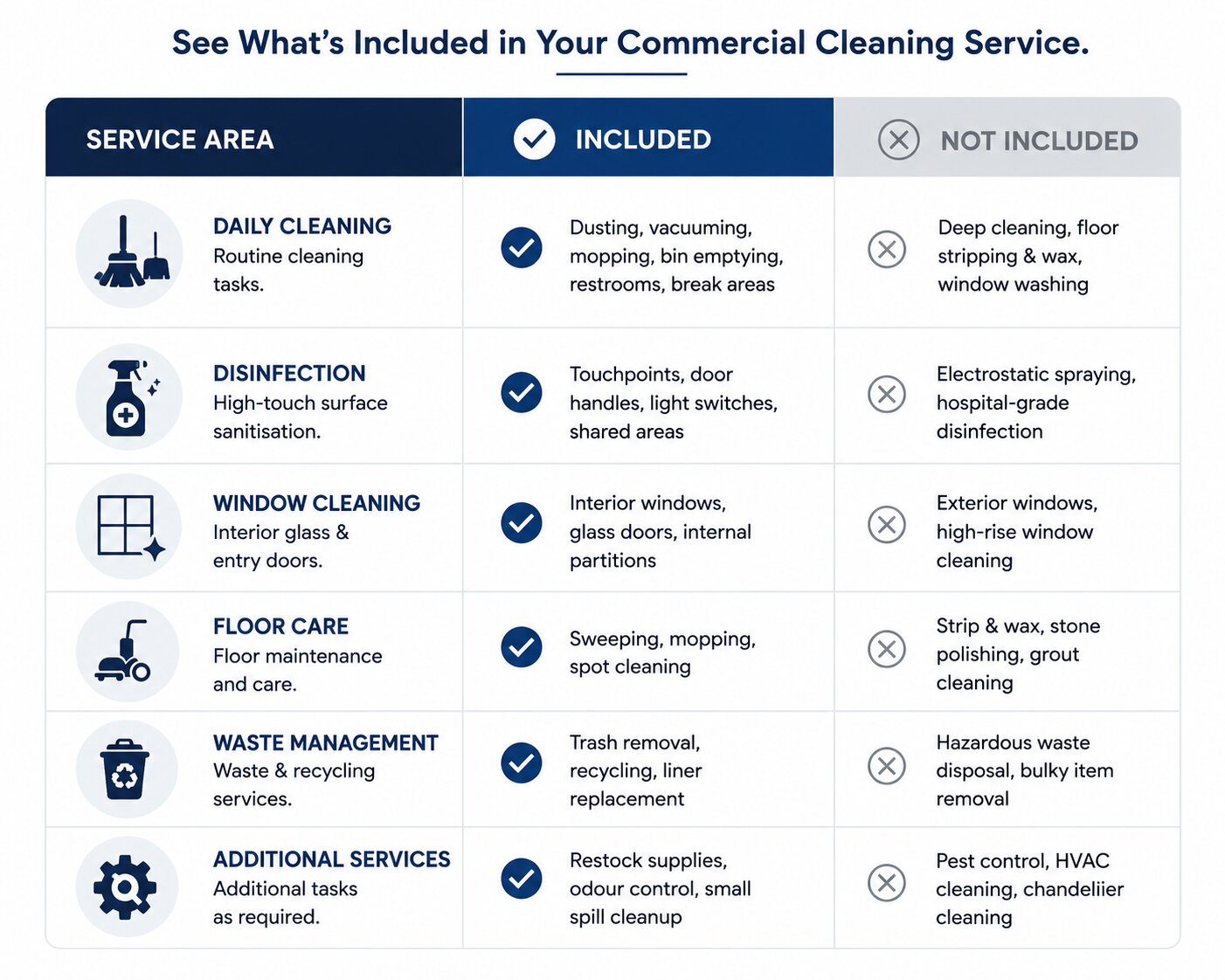
This is the baseline service: trash removal, vacuuming, restroom sanitation, surface wipe-downs, kitchen/break room maintenance, and floor mopping. Most recurring contracts are quoted monthly with a defined visit schedule. Scope documentation should specify exactly which areas are covered, which are excluded, and what consumables (if any) are provided.
Periodic janitorial service is a variation designed for lower-frequency needs quarterly deep cleans, seasonal resets, or supplementing in-house staff. It serves a different function than daily or weekly service, and it’s priced accordingly.
Carpet and Floor Care (Priced Per Sq Ft of Treated Area)
Hot water extraction carpet cleaning typically runs $0.15?$0.35 per square foot of carpet. Hard floor services ,strip and wax, burnishing, scrub and recoat vary by surface and condition. These are periodic services, usually scheduled quarterly or annually, and should be budgeted separately from routine janitorial.
Power Washing (Priced by Project or Linear Foot)
Exterior concrete, building facades, dumpster pads, parking decks, and entryways are typically quoted by project scope rather than interior square footage. Power washing pricing depends on surface type, staining level, water access, and height requirements. Spring and fall scheduling is common for Colorado facilities given the freeze-thaw cycle that accelerates surface deterioration.
Emergency Response and Water Extraction (Priced by Damage Scope)
Flooding, pipe bursts, storm damage, and sewage backups don’t wait for a bid. Water extraction and mitigation is project-priced based on affected area, materials involved, and required drying time. Industry guidelines consistently show that response speed is the single biggest factor in mitigation cost every additional hour water sits increases remediation expense. This is one service category where having a pre-established relationship with a facility services provider pays for itself the first time you need it.
Building Maintenance (Priced by Service Scope or Retainer)
Building maintenance services covering light repairs, bulb replacement, HVAC filter changes, preventive maintenance walkthroughs, and general handyman scope ? are often bundled with cleaning contracts in a full-service model. Consolidated facility management typically reduces total cost versus managing multiple single-service vendors, and significantly reduces the administrative overhead of tracking separate contracts, invoices, and performance conversations.
Real Story: A property manager overseeing a 22,000 sq ft multi-tenant professional office building in the Denver metro area had worked with a low-bid janitorial provider for nearly two years. The pricing was competitive on paper. In practice, tenant complaints accumulated restrooms skipped on busy nights, inconsistent lobby presentation, and a second-floor break room that appeared to be on a different cleaning schedule than the rest of the building.
After switching to a provider with a properly scoped contract, defined checklist accountability, and a dedicated supervisor, complaints from tenants dropped noticeably within the first 60 days. The monthly cost was approximately 12% higher. The property manager described it as the easiest facilities decision they’d made all year.
How to Evaluate and Compare Commercial Cleaning Quotes
Getting three quotes is a reasonable starting point. Getting three comparable quotes is a different challenge and it’s where most facility managers lose confidence in the process.
Step 1: Standardize the Scope
Before you send a single RFP, document exactly what you need: areas to be cleaned, services required, frequency, access requirements, and any special protocols. If every vendor is bidding on the same scope, comparison becomes straightforward. If you let each vendor define their own scope, you’ll end up with three completely different proposals that can’t be compared on price.
Step 2: Separate Routine and Periodic Line Items
Ask every vendor to break out recurring janitorial costs from periodic or specialty services. A quote that bundles quarterly carpet cleaning into the monthly janitorial rate isn’t wrong it’s just harder to evaluate, and harder to adjust when your needs change.
Step 3: Clarify What’s Included
Consumables (paper products, trash liners, hand soap) are sometimes included, sometimes not. Equipment and cleaning products are usually provided by the vendor, but not always. Day porter coverage, holiday scheduling, emergency response availability, and supervisor access should all be addressed explicitly.
Step 4: Ask About Training and Safety Protocols
The Occupational Safety and Health Administration (OSHA) establishes standards for chemical handling, personal protective equipment, and hazard communication that professional cleaning companies are required to follow. Asking about OSHA compliance and employee training isn’t overreach , it’s appropriate due diligence for a service that involves unrestricted access to your building after hours.
The International Facility Management Association (IFMA) also offers benchmarking data and best practices that can help facility managers evaluate cleaning program performance against industry standards.
Step 5: Understand Contract Terms
Month-to-month flexibility costs more than a longer commitment that’s standard. Watch for automatic renewal clauses, price escalation language tied to CPI or labor indices, and termination notice periods. A 90-day termination notice isn’t unusual for large facilities; for small offices, 30 days should be sufficient.
Real Story: A three-story professional services building in Colorado had cycled through two cleaning vendors in 18 months. The problem wasn’t the quality of cleaning on day one and it was that neither contract clearly defined scope boundaries. Over time, cleaning crews were informally handling tasks outside their agreement: removing carpet stains with products not approved for the flooring type, managing exterior entry mats, and restocking restroom supplies on an inconsistent basis because supply procurement wasn’t formally assigned to anyone. When the building moved to a structured contract with separate line items for routine janitorial, periodic carpet care, and basic building maintenance including a defined supply management process service consistency improved immediately. The takeaway: clearly documented scope isn’t bureaucracy, it’s the foundation of a functional vendor relationship.
What Commercial Cleaning Should Cost Your Facility in 2026: A Summary
Here’s how to apply everything in this guide to your specific situation.
For a standard professional office (5,000?20,000 sq ft), cleaned 3?5 days per week: Budget $0.08?$0.14 per square foot per visit. For a 10,000 sq ft office at $0.10/sq ft cleaned five days per week, expect approximately $1,000/week or $4,000?$4,500/month.
Medical, dental, or high-touch facility: Budget $0.15?$0.28 per square foot per visit for routine cleaning, with additional costs for biohazard handling, compliance documentation, and approved disinfection protocols.
Retail, hospitality, or food service: Budget $0.10?$0.20 per square foot, with day porter or daytime coverage adding 20?35% to the base cleaning cost depending on hours and coverage requirements.
Large facilities (50,000+ sq ft): Economies of scale typically bring per-square-foot rates to $0.05?$0.09 for routine service. At this scale, performance-based contracts with defined metrics and regular service reviews become important governance tools.
Small or low-traffic spaces under 3,000 sq ft: Expect minimum visit charges to apply, which effectively raises your per-square-foot rate. Most professional providers have a floor of $100?$175 per visit regardless of size.
Three broader principles hold at every scale:
The cheapest quote is almost never the best outcome. But the most expensive quote isn’t a guarantee of quality either.

Working With a Colorado Commercial Facility Services Partner
Commercial facilities in Colorado have specific considerations that national vendors sometimes underestimate: high-altitude dust accumulation, freeze-thaw cycles that accelerate exterior surface wear, seasonal building traffic patterns from ski season to summer, and a strong culture of environmental stewardship that makes green cleaning certification increasingly relevant to tenants and building owners.
A regional facility services partner with direct Colorado experience brings more than a cleaning crew they bring knowledge of local building codes, vendor ecosystems, and the kind of relationship accountability that a national contract call center can’t replicate. When a pipe bursts at 11PM on a Tuesday, you want a team with a local response infrastructure, not a 1-800 number.
At AboutCFS, we work with commercial property owners, facility managers, and building operators across Colorado to build cleaning and maintenance programs that reflect real scope, honest pricing, and consistent delivery. Our services span routine janitorial, day porter programs, periodic deep cleaning, power washing, floor care, building maintenance, and emergency response structured as individual services or an integrated facility management program depending on your needs.
Get a Quote
Understanding commercial cleaning cost per square foot gives you a baseline. Getting a quote specific to your building, your service requirements, and your operational schedule gives you a number you can actually budget around.
Request a quote from AboutCFS?
Our team reviews your facility details, asks the right questions about scope and access, and returns a transparent, line-item proposal ,no vague ranges, no bait-and-switch pricing after month one.
If you’re not ready for a quote yet, our team is happy to answer questions about service options, frequency recommendations, or what a realistic facility budget looks like for your building type. Start the conversation at aboutcfs.com.


