Walk into any facility manager’s office and mention “cleaning,” and you’ll likely get a knowing sigh. Because “cleaning” can mean a dozen different things and in a commercial setting, using the wrong service at the wrong time costs money, creates compliance headaches, and can leave your workplace less protected than you think.
The confusion between office sanitization vs deep cleaning is one of the most common? and costly, misunderstandings in facility management. Both are essential. Both serve distinct purposes. And mixing them up is a bit like taking aspirin for a broken leg: you’re doing something, but probably not the right thing.
This guide breaks down exactly what separates these two services, when your business needs each one, what they cost, how often to schedule them, and the compliance factors you can’t afford to ignore especially across states like Colorado, Illinois, Indiana, Ohio, Wisconsin, Virginia, and Maryland, where commercial property standards are increasingly scrutinized.
What Is Office Sanitization? (And What It’s Actually Doing)
Sanitization is the process of reducing the number of germs on a surface to a safe level as defined by public health standards. It doesn’t eliminate every microorganism; it reduces them to a point where they no longer pose a significant health risk.
Think of sanitization as your facility’s daily defense layer. It’s fast, frequent, and targeted at the surfaces your team touches most.
What Gets Sanitized?
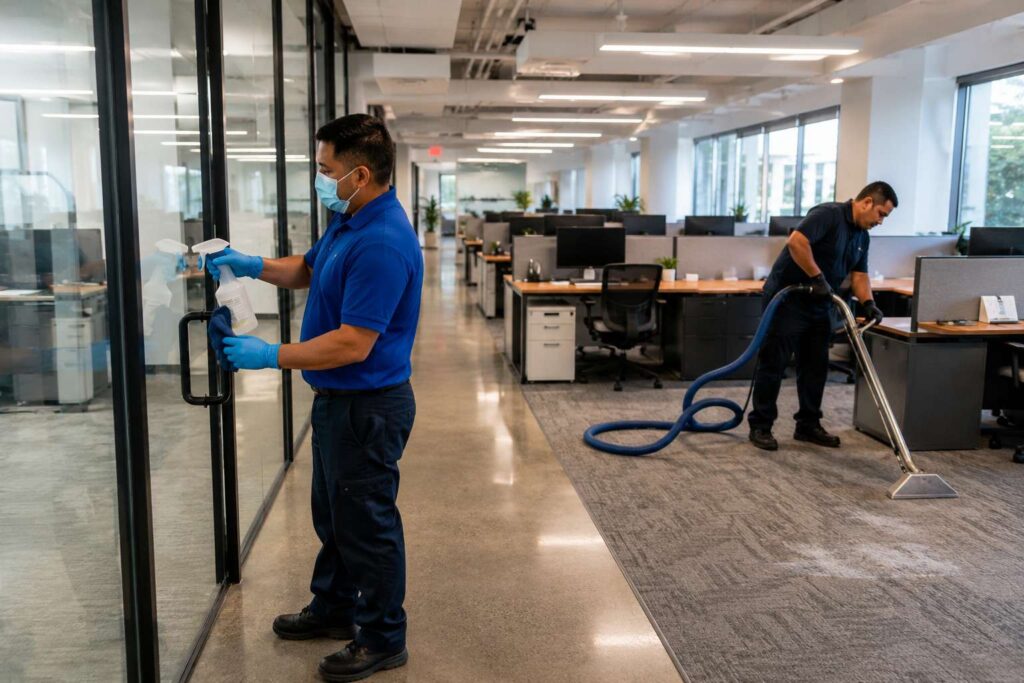
High-touch surface sanitization focuses on the “germ highways” of any office:
- Door handles and push plates
- Elevator buttons
- Light switches
- Keyboard and mouse surfaces
- Conference room phones
- Shared kitchen appliances (coffee makers, microwave buttons, refrigerator handles)
- Restroom fixtures between full cleanings
- Reception area surfaces
Sanitization is typically performed using EPA-registered disinfecting products often applied with microfiber cloths, electrostatic sprayers, or foggers for larger spaces. The key word is targeted. Sanitizers are designed to work quickly on specific contact points.
What Sanitization Doesn’t Do
Here’s where facilities teams sometimes get tripped up: sanitization does not address dirt, grime buildup, grease, soiled grout, degraded upholstery, or contamination in hard-to-reach spaces. It’s surface-level protection literally.
If your carpet is stained, your HVAC vents are dusty, or your breakroom tile grout looks like a science experiment, sanitization won’t touch it. That’s where deep cleaning comes in.
Definition Box Sanitization: The application of EPA-registered products to high-touch surfaces to reduce pathogen levels to a safe threshold. Usually performed daily, weekly, or after illness events. Does not replace routine or deep cleaning.
What Is Office Deep Cleaning? (Going Beyond the Surface)
Deep cleaning is a comprehensive, top-to-bottom cleaning process that addresses the areas routine maintenance and regular sanitization miss entirely. It’s not just “cleaning harder” it’s cleaning differently, in places that rarely get attention and with methods that require more time, equipment, and expertise.
What a Commercial Deep Clean Actually Covers
A professional office deep cleaning typically includes:
Flooring:
- Carpet hot-water extraction (steam cleaning)
- Grout scrubbing on tile floors
- Hard floor stripping, buffing, and resealing
- Under-furniture vacuuming
Walls, Ceilings & Fixtures:
- Baseboard and crown molding wiping
- Light fixture and ceiling fan cleaning
- Air vent and HVAC grille cleaning
- Window sill and blind cleaning
Furniture & Workstations:
- Desk and chair upholstery treatment
- Under-desk and behind-furniture cleaning
- Cable tray and server area dusting
Specialty Areas:
- Kitchen appliance interior cleaning (ovens, microwaves, refrigerators)
- Break room cabinet interiors
- Restroom tile, grout, and fixture descaling
- Storage room organization and cleaning
Deep cleaning is labor-intensive. A standard 5,000 sq ft office might take a professional crew 8?16 hours to deep clean properly. This is not a once-a-week service it’s a periodic reset that restores a facility to a baseline of genuine cleanliness.
Definition Box Deep Cleaning: A thorough, scheduled cleaning process targeting areas missed by routine maintenance. Includes carpet extraction, HVAC vent cleaning, grout scrubbing, interior appliance cleaning, and full surface restoration. Typically performed quarterly, semi-annually, or annually depending on facility use and foot traffic.
Real Story #1:
A regional insurance firm in Columbus, Ohio had maintained a consistent daily janitorial schedule for years. Surfaces looked clean, restrooms were serviced nightly, and the office appeared well-kept. But during a routine HVAC inspection, the technician flagged severely clogged air return grilles packed with years of accumulated dust and debris. Employee complaints about allergies and dry eyes had been climbing for months.
Problem: The firm had been sanitizing and maintaining surfaces, but no deep cleaning protocol existed for ceiling-level fixtures, vents, or behind-wall HVAC components. Solution: A commercial deep cleaning team was brought in for a two-day reset: full vent cleaning, baseboard treatment, carpet extraction, and a thorough kitchen and breakroom overhaul. Outcome: Within three weeks, allergy-related sick days dropped noticeably. The HVAC system ran more efficiently, and the firm established a quarterly deep cleaning schedule going forward. Lesson: Regular sanitization maintains safety at the surface. Deep cleaning protects air quality and structural cleanliness and it takes a real event to reveal the gap between the two.
Office Sanitization vs Deep Cleaning: A Side-by-Side Comparison
| Feature | Office Sanitization | Deep Cleaning |
| Primary Goal | Reduce pathogen levels on contact surfaces | Remove embedded dirt, grime, and contaminants throughout facility |
| Frequency | Daily, weekly, or after illness events | Quarterly, semi-annually, or annually |
| Time Required | 30 min ? 2 hours (typical office) | 8?20+ hours depending on size |
| Areas Covered | High-touch surfaces only | Floors, walls, vents, furniture, appliances, hidden areas |
| Products Used | EPA-registered sanitizers and disinfectants | Industrial cleaners, extraction equipment, degreasers |
| Trained Staff Needed | Standard janitorial staff with product training | Specialized commercial cleaning crew |
| Typical Cost | $0.05?$0.15 per sq ft per visit | $0.20?$0.50+ per sq ft per service |
| Compliance Relevance | OSHA illness prevention, HACCP (food areas) | OSHA, EPA, building code compliance |
| Best For | Ongoing health maintenance | Seasonal resets, post-construction, post-illness, move-in/out |
| Visible Results | Subtle (pathogen reduction, not dirt removal) | Highly visible (restored surfaces, fresh environments) |
When Does Your Office Need Sanitization vs Deep Cleaning?
This is the practical question most guides skip over. The answer isn’t one or the other both belong in your facility maintenance plan. The question is when and how often.
Schedule Regular Sanitization When:
- You have 10+ employees working in-office daily
- Cold and flu season begins (October through March in most Midwest and Mid-Atlantic states)
- A confirmed illness (flu, COVID-19, norovirus) has affected the workplace
- You operate a high-traffic reception area, shared kitchen, or public restroom
- You’re in a regulated industry (healthcare-adjacent, food service, childcare)
Schedule a Deep Clean When:
- It’s been 90+ days since your last one
- You notice persistent odors, stained carpet, or grimy grout
- Seasonal transitions (end of winter, post-summer) particularly relevant in Wisconsin, Indiana, and Montana where seasonal grime is real
- Post-construction or office renovation
- Moving into or out of a commercial space
- Before a major client visit, all-hands event, or building inspection
- After a significant illness outbreak in the facility
Key Takeaway Box: Sanitization = ongoing protection between deep cleans. Deep cleaning = periodic restoration that makes sanitization more effective. Running sanitization on a facility that hasn’t been deep cleaned in 18 months is like polishing a dirty window you’re improving the surface, but the underlying problem remains.
Cost Breakdown: What Should You Actually Budget?
Pricing in commercial cleaning varies by region, facility size, soil level, and service provider quality. Here are realistic estimates based on industry standards for the states CFS serves.
Office Sanitization Costs
- Per-visit flat rate (small office, under 2,000 sq ft): $75?$200
- Monthly sanitization contract (mid-size office, 5,000?10,000 sq ft): $400?$900/month
- Electrostatic spraying / fogging (large open plan): $0.08?$0.15 per sq ft per visit
- Post-illness emergency sanitization: $200?$600+ depending on scope
Deep Cleaning Costs
- Small office (under 2,500 sq ft): $300?$800 per service
- Mid-size office (5,000?15,000 sq ft): $1,200?$3,500 per service
- Large commercial facility (15,000?50,000 sq ft): $3,500?$12,000+ per service
- Specialty add-ons (carpet extraction, HVAC vent cleaning, floor resurfacing): Priced separately
The smart play: Bundle deep cleaning into a quarterly or semi-annual contract with your commercial cleaning provider. Most vendors offer 10?20% savings on bundled services vs. one-off bookings.
Real Story #2:
A property management firm overseeing a mixed-use commercial building in Kansas City, Missouri faced a recurring tenant complaint: the shared lobby always felt “musty” regardless of how often it was cleaned. Nightly janitorial staff performed consistent sanitization and mopping. But the smell persisted.
Problem: The building’s lobby carpet (installed six years prior) had never received professional extraction. Routine mopping of surrounding tile had pushed moisture into the carpet edge creating a persistent mildew issue invisible to the eye but very present to the nose.
Solution: A commercial deep cleaning team performed hot-water extraction on the lobby carpet, cleaned HVAC vents serving the lobby zone, stripped and resealed the tile, and treated the baseboard area with an antimicrobial solution.
Outcome: The odor was eliminated within 48 hours. Tenant satisfaction scores for the lobby improved on the next quarterly survey. The property manager added a semi-annual deep cleaning line item to the building’s maintenance budget.
Lesson: Routine sanitization maintains a facility. Deep cleaning restores it. When tenants notice problems despite regular cleaning, deep cleaning is usually the missing piece.
Compliance and Regulatory Considerations
This section matters more than most cleaning guides acknowledge. Across the states CFS serves Colorado, Illinois, Indiana, Ohio, Virginia, Maryland, Wisconsin, Nebraska, Wyoming, Kansas, and Montana commercial facilities face overlapping compliance requirements that touch directly on cleaning practices.
OSHA Standards
OSHA’s General Duty Clause (Section 5(a)(1)) requires employers to provide a workplace free from recognized hazards. A consistent sanitization program is your documented defense against illness-related hazard claims. Maintain cleaning logs.
EPA Registered Disinfectants
Any product claiming to “kill germs” in a commercial setting must be EPA-registered (List N for COVID-19; other lists for specific pathogens). Using non-registered products in a facility and calling it sanitization can create liability exposure.
State-Specific Considerations
- Illinois & Ohio: Strong state OSHA programs with independent enforcement authority documentation of cleaning protocols is advisable.
- Maryland & Virginia: Active commercial property inspection regimes in metro areas (Baltimore, Richmond, Northern Virginia suburbs).
- Colorado: State health department guidance for commercial facilities references EPA List N products explicitly post-2020.
- Montana & Wyoming: Lower regulatory density, but OSHA federal standards still apply fully.
Pro Tip: Ask your commercial cleaning provider to supply a Certificate of Compliance and product data sheets (SDS) for all products used. This protects you in the event of an employee illness claim or building inspection.
Pro Tips: Getting the Most from Both Services
-
Maintain a Cleaning Log
Document every sanitization service and every deep clean. Date, scope, products used, areas covered. This is your paper trail for OSHA compliance and liability protection and it costs nothing extra.
-
Don’t Skip Deep Cleans to Cut Costs
Facilities that skip deep cleaning eventually pay more in carpet replacement, HVAC repair, grout restoration, and employee sick days. A quarterly deep clean averaging $1,500 for a mid-size office is meaningfully cheaper than carpet replacement at $8?$15 per sq ft.
-
Time Deep Cleans Strategically
Schedule them when office occupancy is lowest: holidays, long weekends, summer slowdowns. This minimizes disruption and lets cleaning crews work without navigating around employees.
-
Communicate With Your Team
Let employees know when a deep clean is scheduled and when a sanitization event occurs after an illness. Transparency builds trust and reinforces your commitment to a healthy workplace which matters for retention.
-
Evaluate Your Cleaning Provider Annually
Ask for updated product data sheets, confirm EPA registration status of disinfectants, and review scope-of-work agreements. The commercial cleaning industry evolves; your contract should reflect current standards.
Conclusion: Know the Difference, Build the Right Plan
The debate of office sanitization vs deep cleaning isn’t really a debate at all it’s a false choice. Your workplace needs both, applied at the right times and for the right reasons.
Sanitization is your ongoing protection. It keeps daily pathogen loads in check, supports employee health, and demonstrates a commitment to workplace safety that your team will notice. Deep cleaning is your periodic reset ,the service that restores your facility to the baseline that makes everything else work.
The most common mistake facilities teams make: Treating sanitization as the whole solution and neglecting deep cleaning until something goes visibly wrong. By then, the carpet’s been compromised, the HVAC is strained, and you’re looking at restoration costs that dwarf what a consistent deep cleaning program would have cost.
Build the plan:
- Daily or weekly sanitization of high-touch surfaces
- Quarterly deep cleaning (or more frequently for high-traffic facilities)
- Documented cleaning logs for compliance
- Annual review of products, providers, and protocols
If you’re unsure where your facility stands or what combination of services makes sense for your building’s size, use, and occupancy that’s exactly the conversation we have every day.
Ready to stop guessing and start cleaning smart? Contact Commercial Facility Services to schedule a complimentary facility walkthrough and customized cleaning plan for your building.


