Understanding commercial cleaning costs is essential for facility managers and business owners seeking to optimize operational budgets. The commercial cleaning cost per square foot remains one of the most critical metrics in facility management decision-making. In 2026, pricing structures have evolved significantly, influenced by labor market changes, technological advancements, and shifting service expectations. This comprehensive guide explores current pricing models, factors influencing costs, and strategies to maximize value while maintaining pristine facility conditions.
Understanding Commercial Cleaning Pricing Models
The Per-Square-Foot Pricing Structure
The per-square-foot model represents the industry standard for commercial cleaning services. This pricing approach divides the total service cost by the facility’s square footage, providing a straightforward cost metric for budget planning and vendor comparison.
In 2026, commercial cleaning cost per square foot typically ranges from $0.05 to $0.20 per square foot for standard maintenance cleaning, depending on multiple variables. Premium services, specialized treatments, and high-traffic facilities may exceed these baseline figures. Understanding this metric allows facility managers to benchmark costs against industry standards and identify potential inefficiencies.
The per-square-foot model offers transparent pricing that scales with facility size, making it easier to forecast annual facility management expenses. A 50,000-square-foot office building might spend between $2,500 and $10,000 monthly on routine janitorial services using this calculation method.
Alternative Pricing Models in 2026
Beyond per-square-foot pricing, commercial facilities increasingly adopt alternative pricing structures:
Hourly Rate Model: Some service providers charge hourly rates ranging from $25 to $60 per hour, depending on staff expertise and geographic location. This model works well for specialized services or variable workloads.
Monthly Retainer Model: Facility managers negotiate fixed monthly fees covering specific service levels. This provides budget predictability and often results in better rates for committed contracts.
Performance-Based Pricing: Increasingly, facilities use pricing models tied to cleanliness metrics and satisfaction benchmarks. This incentivizes service quality and accountability.
Factors Influencing Commercial Cleaning Costs
Facility Type and Industry Requirements
Different facility types demand varying cleaning standards and methodologies, directly impacting commercial cleaning cost per square foot. Understanding industry-specific requirements helps justify budget allocations.
Office Buildings: Standard office spaces typically require basic vacuuming, dusting, restroom sanitation, and trash removal. These facilities generally fall at the lower end of the pricing spectrum.
Healthcare Facilities: Hospitals, medical offices, and clinics demand specialized disinfection protocols, medical-grade cleaning standards, and HIPAA compliance measures. Costs increase 40-60% compared to standard office cleaning.
Manufacturing and Industrial Facilities: Heavy machinery, specialized equipment, and contamination concerns require industrial-strength cleaning solutions and specialized training. Costs may double or triple standard office cleaning rates.
Retail Establishments: High-traffic customer areas, multiple restroom facilities, and stringent appearance standards increase cleaning requirements and associated costs.
Educational Institutions: Schools and universities need thorough cleaning protocols, specialized floor care, and frequent deep-cleaning cycles during breaks.
Geographic Location and Labor Markets
Geographic variation remains a significant cost driver. Urban centers with high cost-of-living indices typically show 25-40% higher cleaning costs than rural areas. Specific regional factors include:
- Local wage standards and labor market conditions
- Cost of specialized cleaning chemicals and equipment
- Transportation and fuel expenses
- Regional building code requirements
- Climate considerations affecting facility maintenance needs
A 10,000-square-foot facility in New York City might cost $2,000 monthly for cleaning services, while the same facility in a secondary market might cost $1,200-$1,400 monthly.
Cleaning Frequency and Service Levels
Service frequency dramatically affects pricing calculations. Most commercial facilities employ one of three standard service levels:
Daily Cleaning: Five to seven days per week service, typically performed during business hours or evening shifts. This premium option ensures constant facility cleanliness and costs 35-50% more than standard schedules.
Standard Cleaning: Three to five days per week service, matching typical business operating schedules. This represents the most common arrangement and serves as the pricing baseline.
Reduced Service: One to two days per week maintenance cleaning, suitable for low-traffic facilities or supplemental services. This economical option reduces costs 25-40% below standard rates.
Additional frequency-related expenses include 24-hour emergency response availability, which adds 15-25% to base service costs for facilities requiring rapid response to spills, facility issues, or emergency situations.
Facility Condition and Maintenance Requirements
The current condition of facility infrastructure significantly impacts cleaning costs. Well-maintained facilities with modern flooring, appropriate HVAC systems, and minimal damage require standard cleaning rates. However, facilities with outdated infrastructure, damaged surfaces, or specialized materials may incur premium costs.
Carpet vs. Hard Flooring: Carpet cleaning requires different techniques than tile or hardwood floors. Facilities with extensive carpeting typically pay 15-25% more than hard-floor-only facilities due to specialized vacuuming and spot-cleaning requirements.
Specialized Flooring Materials: Marble, polished concrete, or specialty commercial flooring demands expert care and premium cleaning solutions, increasing costs 20-35%.
Graffiti-Prone Facilities: Facilities in urban areas or experiencing frequent vandalism require specialized graffiti removal services, adding $500-$3,000+ monthly depending on incident frequency.
Detailed Cost Breakdown for 2026
Standard Commercial Cleaning Services
Breaking down the commercial cleaning cost per square foot into service components provides transparency and helps identify cost optimization opportunities:
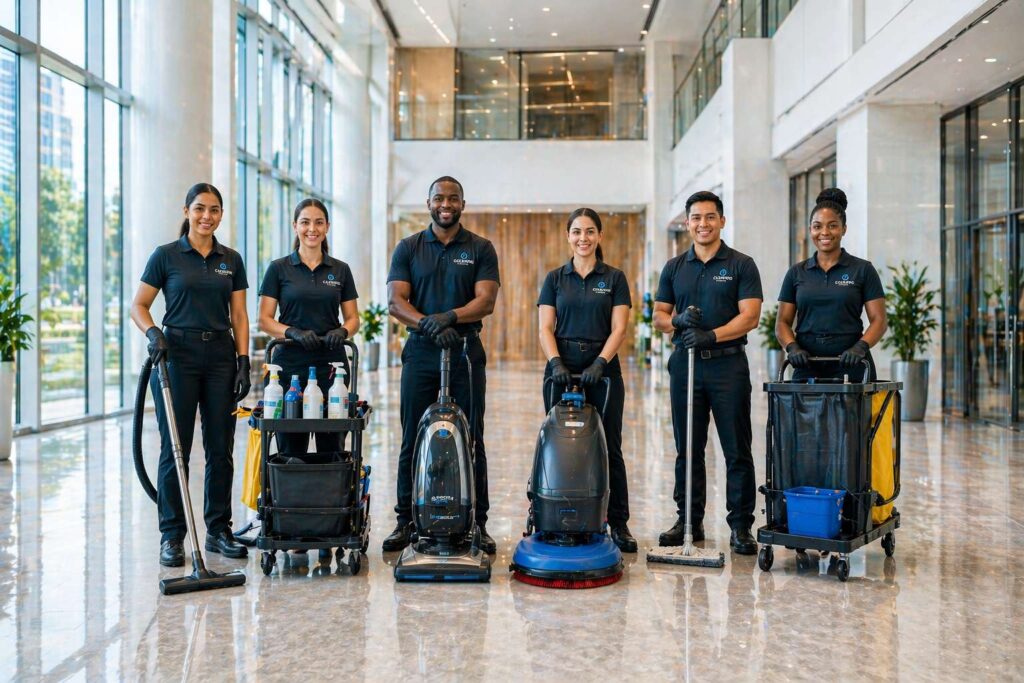
Restroom Cleaning and Sanitization: 25-35% of cleaning costs, including toilet, sink, and floor sanitation, soap and paper product restocking, and disinfection protocols.
Floor Care and Maintenance: 30-40% of cleaning expenses, encompassing vacuuming, mopping, and specialized floor treatments including carpet shampooing or hard-floor reconditioning.
Common Area Cleaning: 15-20% of costs, covering lobby areas, hallways, stairwells, and public spaces including dusting, trash removal, and surface cleaning.
Specialized Services: 10-20% of expenses, including window washing, power washing, graffiti removal, or building exterior maintenance.
Specialized Service Premiums
Beyond standard janitorial services, facility managers often budget for specialized services:
Carpet and Floor Reconditioning: $0.15-$0.50 per square foot annually for deep cleaning, restoration, and specialized treatments. High-traffic areas may require quarterly service.
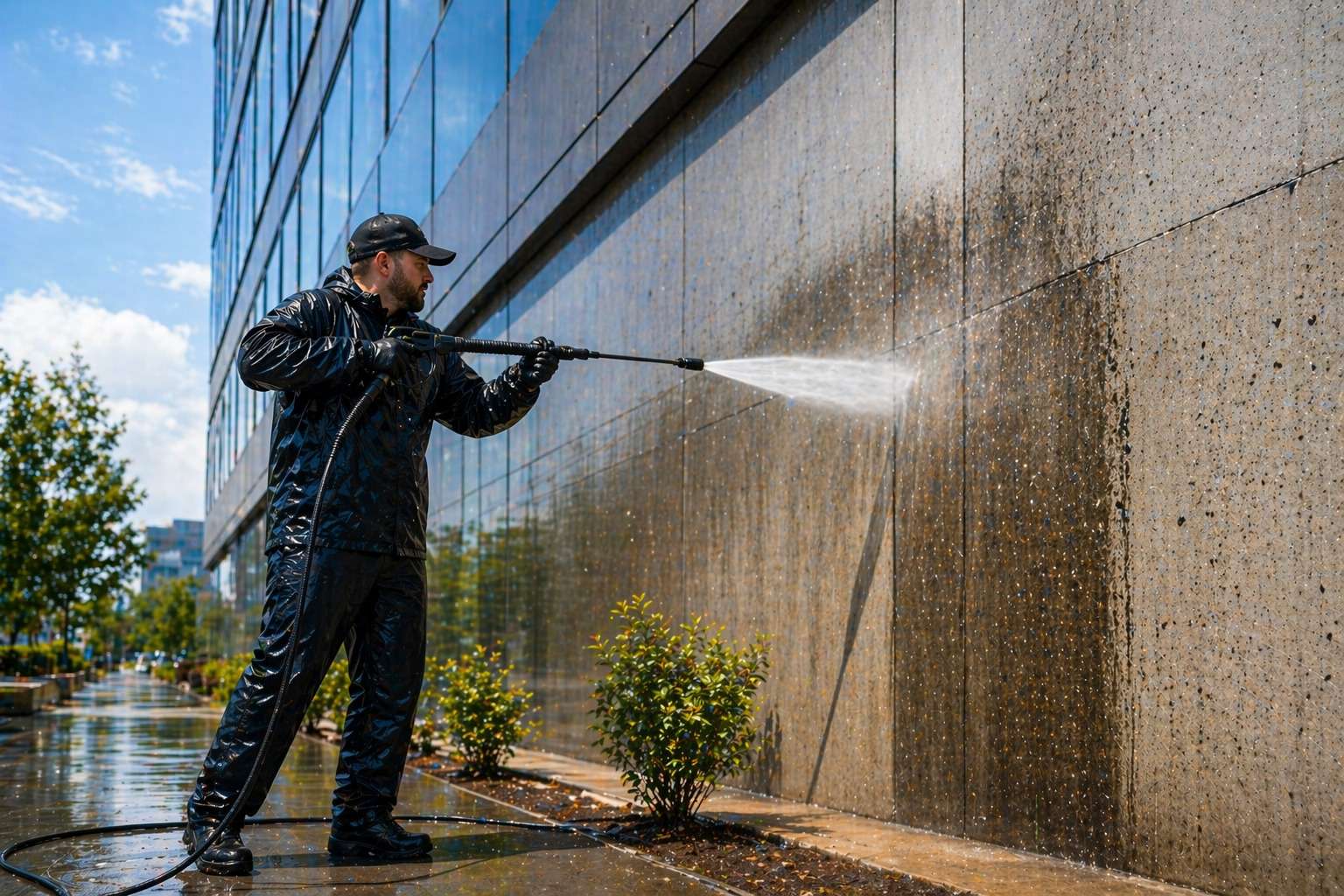
Power Washing: Exterior surfaces typically cost $0.03-$0.15 per square foot, depending on surface material and contamination levels.
Window Washing: Commercial window services range from $50-$300 per visit depending on facility height, window complexity, and frequency. Most facilities budget for quarterly to semi-annual service.
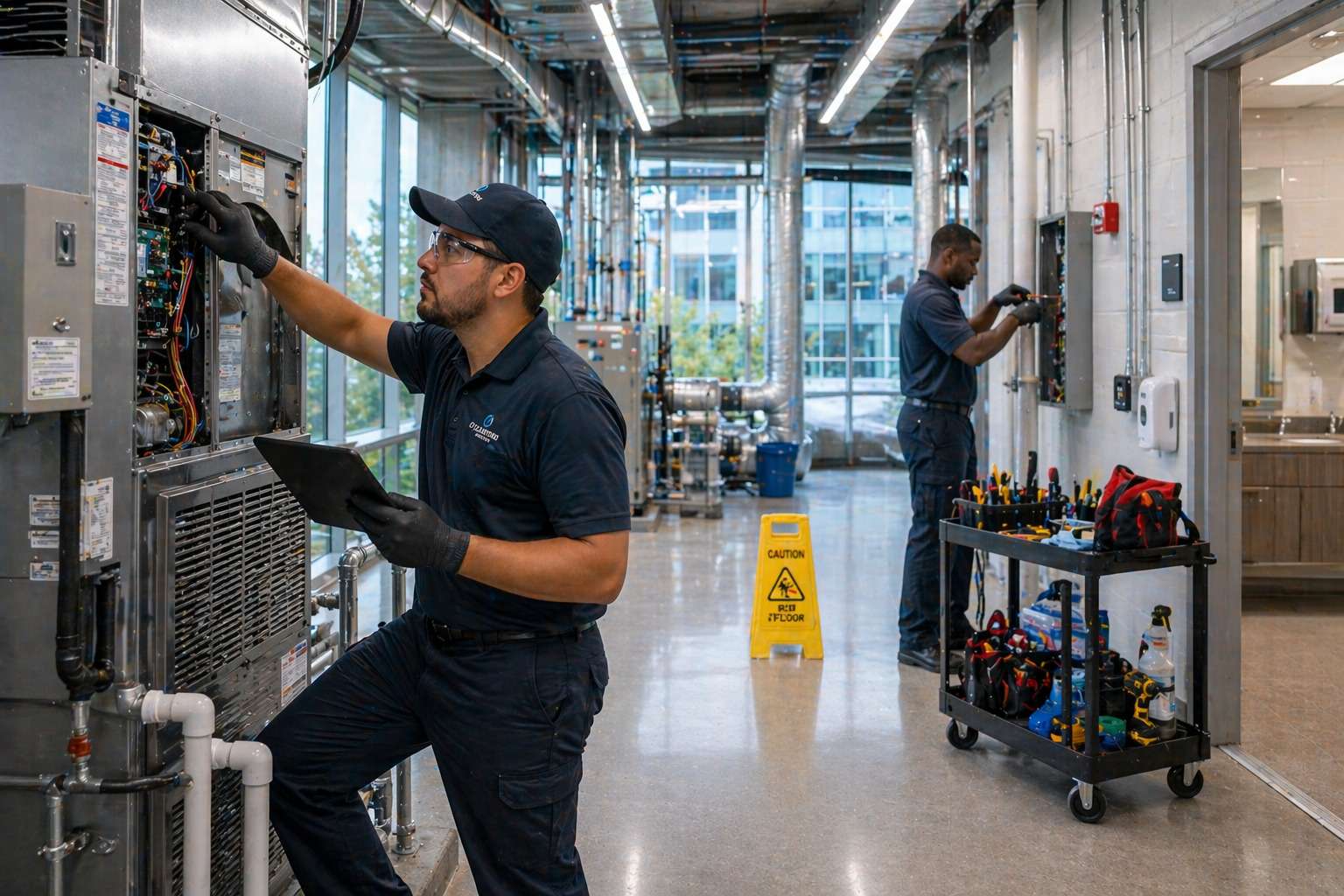
Building Maintenance: General maintenance and small repairs typically add $50-$300 monthly to facility service budgets.
Emergency Response Services: 24-hour emergency water extraction, cleanup, and mitigation services add $200-$500 monthly to base facility costs, with additional charges for actual emergency response.
Industry Benchmarks and Regional Variations
Commercial Cleaning Costs by Region
Understanding regional variations helps facility managers assess whether their current service pricing remains competitive:
Northeast (Major Urban Centers): $0.12-$0.25 per square foot, reflecting high labor costs and premium service expectations. New York, Boston, and Philadelphia typically fall at the higher end.
Midwest (Mixed Urban/Rural): $0.07-$0.15 per square foot, offering moderate pricing with reasonable service quality standards.
Southern States: $0.06-$0.14 per square foot, featuring competitive pricing with growing service industry sophistication.
Western Markets: $0.10-$0.20 per square foot, with significant variation between tech hubs (premium pricing) and secondary markets (moderate pricing).
Industry-Specific Cost Comparisons
Financial Services: $0.15-$0.25 per square foot, reflecting rigorous cleanliness standards, security requirements, and professional appearance expectations.
Technology and Corporate Offices: $0.10-$0.18 per square foot, balancing modern facility expectations with cost consciousness.
Retail and Hospitality: $0.12-$0.22 per square foot, driven by customer-facing appearance requirements and extended operating hours.
Manufacturing and Warehousing: $0.05-$0.12 per square foot, with lower costs offset by specialized contamination removal requirements.
Healthcare and Medical: $0.18-$0.35 per square foot, reflecting stringent sanitation standards and specialized disinfection protocols.
Maximizing Value in Commercial Facility Services
Strategic Vendor Selection
Selecting the right facility service provider extends beyond securing the lowest commercial cleaning cost per square foot. Comprehensive evaluation criteria include:
Experience and Credentials: Established service providers with industry certifications, proven track records, and appropriate insurance coverage typically deliver superior results justifying premium pricing. Verify vendor credentials, including OSHA compliance, bonding, and liability insurance.
Service Quality Standards: Request client references, quality assurance metrics, and satisfaction guarantees. Premium vendors typically offer performance-based agreements with remedy provisions for service deficiencies.
Staffing Stability: Vendors maintaining stable, trained staff deliver superior results compared to high-turnover operations. Inquire about staff training programs, background checks, and employee retention rates.
Technology Integration: Modern facility service providers leverage technology for scheduling optimization, quality verification, and communication. Technology-enabled services often justify higher costs through improved efficiency and accountability.
Cost Reduction Strategies
Facility managers can implement several strategies to optimize cleaning expenditures without compromising facility appearance:
Service Consolidation: Bundling multiple services (janitorial, floor care, window washing) with single vendors often reduces costs 10-20% compared to separate service contracts.
Schedule Optimization: Shifting cleaning operations to off-peak hours, extending service intervals for low-traffic areas, or implementing targeted cleaning for high-impact zones reduces costs while maintaining facility standards.
Equipment and Supply Management: Providing cleaning supplies rather than including them in vendor fees often reduces costs 5-15%. Negotiate bulk chemical purchasing agreements for additional savings.
Performance-Based Pricing: Structuring contracts around specific cleanliness benchmarks incentivizes efficiency while protecting facility quality standards.
In-House vs. Outsourcing Analysis: Periodically evaluate whether in-house cleaning teams might cost-effectively supplement outsourced services. Many facilities optimize using hybrid approaches.
The Impact of Technology on 2026 Cleaning Costs
Automation and Efficiency Innovations
Emerging technologies continue reshaping facility service cost structures. Robotic vacuuming systems, UV disinfection equipment, and IoT-enabled monitoring systems enable service providers to maintain quality while reducing labor hours. These technologies increasingly appear in commercial cleaning service offerings, though adoption timelines vary by vendor and facility type.
Facilities investing in modern infrastructure often negotiate better rates due to compatibility with advanced cleaning methodologies. Conversely, facilities with outdated layouts or equipment may incur premium costs due to service complexity.
Digital Management Systems
Software platforms for scheduling, quality verification, and communication reduce administrative overhead while improving accountability. Vendors utilizing advanced management systems typically command slight premium pricing offset by superior service quality and reduced oversight requirements.
Planning Your 2026 Commercial Cleaning Budget
Comprehensive Cost Estimation Framework
Effective facility budgeting requires understanding all cost components:
Base Janitorial Services: Calculate using your facility square footage multiplied by your region’s standard per-square-foot rate. For a 25,000-square-foot facility in the Midwest using $0.10 per square foot pricing, expect approximately $2,500 monthly or $30,000 annually.
Specialized Services: Add costs for floor reconditioning, power washing, window washing, and other specialized treatments. Annual specialized service budgets typically range from $3,000-$15,000 depending on facility type and condition.
Emergency Response: Allocate $2,400-$6,000 annually for 24-hour emergency response capabilities, or higher for facilities with specific vulnerability concerns.
Equipment and Technology: Modern facility service contracts increasingly include specialized equipment costs. Budget 5-10% above base janitorial costs for equipment rental or depreciation.
Contingency Buffer: Maintain a 10-15% contingency budget for emergency services, unexpected maintenance, or seasonal increases.
Common Pricing Pitfalls and How to Avoid Them
Underestimating Facility-Specific Requirements
Many facility managers price services based on industry averages without accounting for unique facility characteristics. Specialized equipment, unusual layouts, or contamination concerns require site-specific assessments rather than generic pricing templates.
Inadequate Contract Specifications
Vague service descriptions lead to disputes and scope creep. Detailed contracts should specify cleaning frequencies, service areas, quality standards, and response times, protecting both facility managers and service providers.
Overlooking Hidden Charges
Request itemized quotes disclosing all potential charges including supply costs, emergency fees, equipment rentals, and travel expenses. Transparent pricing prevents budget surprises.
Long-Term Contract Lock-In
Avoid excessive contract lengths that limit flexibility and lock in potentially outdated pricing. Negotiate performance review provisions and price adjustment mechanisms tied to industry benchmarks.
The Future of Commercial Cleaning Costs
Looking ahead to 2027 and beyond, several trends will likely influence commercial cleaning cost per square foot:
Labor Market Pressures: Continued wage growth in service industries will likely increase cleaning costs 3-5% annually. Facilities must factor inflation into long-term budget planning.
Sustainability Expectations: Green cleaning practices, eco-friendly products, and waste reduction initiatives add 5-15% to service costs but provide environmental and health benefits.
Compliance Requirements: Evolving health, safety, and environmental regulations may increase service complexity and associated costs.
Technological Integration: As automation increases, facilities embracing technology may achieve cost efficiencies, while others face premium costs for specialized services.
Conclusion: Making Informed Commercial Facility Service Decisions
Understanding commercial cleaning cost per square foot provides essential context for facility budgeting and vendor selection. In 2026, pricing ranges from $0.05 to $0.25 per square foot depending on facility type, location, service frequency, and specialized requirements. Rather than seeking the lowest possible cost, facility managers should evaluate total value including service quality, provider reliability, and long-term partnership potential.
Comprehensive facility management extends beyond basic janitorial services to encompass specialized services including carpet reconditioning, power washing, building maintenance, and emergency response capabilities. Strategic vendor selection, performance-based contracts, and technology integration enable facilities to maintain pristine conditions while optimizing operational expenses.
AboutCFS provides comprehensive commercial facility services designed to meet diverse business needs. From routine periodic janitorial service to specialized building maintenance, carpet and floor reconditioning, power washing, emergency response, and complete facility renovation services, AboutCFS delivers professional solutions across all facility service categories. Our experienced team understands that facility appearance and cleanliness directly impact business success, employee satisfaction, and client impressions.
Whether you operate a small office, manage a large commercial complex, or oversee industrial facilities, AboutCFS offers customized solutions aligned with your budget and service requirements. Our transparent pricing, professional staff, and comprehensive service portfolio ensure your facility maintains the appearance and condition your business deserves.
Contact AboutCFS today for a facility assessment and customized service proposal. Let our experienced team help you optimize facility costs while exceeding cleanliness and maintenance standards. Your facility excellence is our commitment.


