Day Porter vs Janitorial Service: Which One Does Your Colorado Office Actually Need?
Most Colorado office buildings do not have a cleaning problem. They have a timing problem. The building gets cleaned after employees leave, but tenants, visitors, spills, restroom traffic, and break room messes continue throughout the business day. That gap is where complaints start.
A janitorial contract handles scheduled cleaning, while a day porter provides daytime, on-site cleaning support while the building is occupied. The right choice depends on occupancy, foot traffic, tenant expectations, building size, and how quickly problems need to be addressed.
This guide explains what a day porter service actually includes, the day porter vs janitorial service difference, when each makes sense, and how Colorado property managers can decide whether daytime coverage is worth the additional cost.
Why Do Tenants Keep Complaining About Bathroom Cleanliness Despite Cleaning?
This is one of the easiest situations to misunderstand. A property manager can have a legitimate cleaning contract, documented nightly service, and a crew that completes its assigned tasks and still receives bathroom complaints every afternoon.
The reason is simple: cleaning after hours does not control what happens during business hours.
A restroom cleaned at 7 p.m. may be spotless when the last employee leaves. By 10 a.m., dozens or hundreds of people may have used it. Paper products need restocking. Counters need wiping. Floors may need spot cleaning. Fixtures may need attention. None of those problems necessarily mean the nighttime cleaning crew failed.
They mean the building needs someone available while the building is actually being used.
This is where understanding the difference between janitor and day porter becomes important. A janitorial crew generally works according to a scheduled cleaning scope, often before or after normal business hours. A day porter works during occupancy and responds to the conditions created throughout the day.
For property managers, that distinction changes how tenant complaints should be diagnosed.
If the complaint is that the restroom was not cleaned overnight, review the janitorial scope.
If the complaint is that the restroom looked fine in the morning but needed attention by lunchtime, the issue is probably not the nighttime cleaning schedule. It is the absence of daytime coverage.
The same pattern appears in lobbies, elevators, entrances, kitchens, conference areas, and shared corridors. A building can be professionally cleaned every evening and still look poorly maintained by 2 p.m. because the building is producing new mess faster than anyone is available to address it.
A commercial building day porter service closes that operational gap.
The test every property manager should apply:
If your building looks clean at 8 a.m. but generates recurring complaints by noon, you may not need more nighttime cleaning. You may need daytime coverage.
What Is a Day Porter and What Do They Actually Do During Business Hours?
So, what is a day porter service?
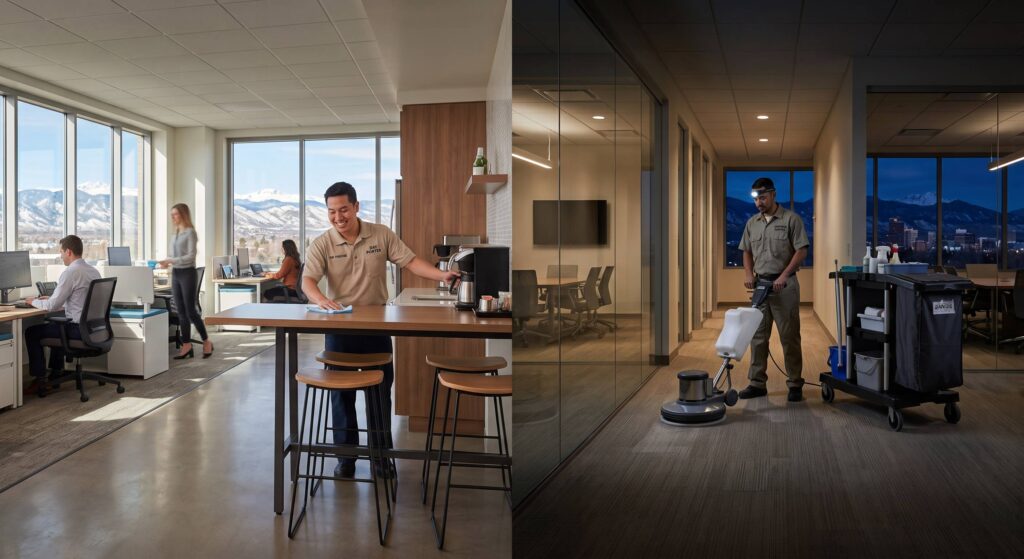
A day porter is an on-site cleaning and facility-support professional who works during the building’s active hours. Instead of waiting until the end of the day to address accumulated problems, the porter handles visible cleaning, restocking, touch-ups, spill response, and common-area maintenance as those needs occur.For a broader look at how day porter services fit into a complete facility management program, see our guide to day porter services as part of facility management.
The exact day porter duties and responsibilities depend on the building, but the purpose remains consistent: keep occupied areas presentable and functional throughout the business day.
Typical responsibilities can include:
- Restroom inspections and touch-up cleaning
- Restocking toilet paper, paper towels, soap, and other supplies
- Lobby and entrance spot cleaning
- Immediate spill response
- Elevator and common-area touch-ups
- Break room and shared kitchen cleaning
- Emptying or servicing high-use waste containers
- Spot cleaning carpets and hard floors
- Cleaning visible glass and entrance doors
- Monitoring common areas for cleanliness issues
- Reporting maintenance problems noticed during routine rounds
The important distinction is that a porter is not simply a janitor working at a different time.
The job is built around continuous observation and response.
A porter may notice a restroom dispenser running empty, a spill near an elevator, salt tracked through an entrance after a Colorado snowstorm, or a break room that needs attention before the next tenant meeting. Those issues can be handled before they become complaints.
For a high-occupancy office, that responsiveness can matter more than adding another nighttime cleaning visit.
A useful way to think about it is:
Janitorial service maintains the building on a scheduled basis. Day porter service maintains the building while people are using it.
That distinction is especially relevant to day porter services for office buildings Colorado, where seasonal weather can create additional daytime cleaning demands around entrances, lobbies, and shared areas.
Day Porter vs Janitorial Service: Side-by-Side Comparison
The day porter vs janitorial service difference is primarily about timing, scope, and response.
A janitorial contract is usually the foundation. It establishes the recurring work needed to maintain the facility: vacuuming, restroom cleaning, waste removal, mopping, surface cleaning, and other scheduled tasks.
A day porter adds another layer.
The porter is there when tenants and visitors are actually moving through the building.
Which Is Better for a Multi-Tenant Office Building in Colorado?
Multi-tenant office buildings are where the day porter vs janitorial service difference becomes most important. You have common areas used by everyone, private tenant suites with different occupancy levels, and shared restrooms, elevators, lobbies, stairwells, and break rooms that building management is responsible for. The mistake is treating every area as if it needs the same cleaning schedule.
The structure that works best for most Colorado multi-tenant properties is a three-layer model. Each layer has a different purpose, different service timing, and different responsibility. This also makes the janitorial contract vs day porter contract easier to define and manage.
During Business Hours
- Lobby floors, elevator interiors, shared restrooms, stairwells, entrances, and break rooms used by multiple tenants need attention while the building is occupied.
- A day porter service can handle restroom touch-ups, spills, visible debris, supply restocking, and other problems before they become tenant complaints.
- Colorado weather makes daytime entrance coverage particularly important during snow, slush, and winter road-salt conditions when floors can deteriorate quickly between scheduled cleaning visits.
Nightly or 2x Week
- Individual tenant suites remain on their own scheduled janitorial scope, including vacuuming, dusting, waste removal, restroom cleaning, and other routine tasks.
- Frequency should be based on actual occupancy and use rather than applying the same schedule to every suite in the building.
- A four-person professional office has very different cleaning requirements from a 40-person open-plan company occupying a similar amount of space, so the scope should be defined by suite.
- Periodic service covers work that routine daytime and nighttime cleaning does not reach, including carpet extraction, detailed floor care, exterior window cleaning, and other deeper maintenance tasks.
- Shared restrooms, high-traffic corridors, lobby surfaces, entry areas, and other heavily used zones should be reviewed regularly for buildup that ordinary cleaning does not remove.
- This is the layer property managers often underinvest in, even though accumulated soil, moisture, and wear eventually contribute to odors, premature surface deterioration, and tenant complaints.
Which Is Cheaper: Day Porter or a Janitorial Contract?
This is where the question how much does a day porter cost becomes more complicated than simply comparing two hourly rates.
A janitorial contract generally covers a defined scope at scheduled intervals. A day porter requires labor during occupied hours, so the cost depends on the hours of coverage, building size, traffic, responsibilities, and service frequency.
There is no responsible single price that applies to every Colorado property.
The more useful comparison is cost against operational need.
If a 20-person office has modest traffic and one restroom, adding full-time daytime coverage may make little financial sense.
If a 300-person multi-tenant building has heavy lobby traffic, shared restrooms, frequent visitors, multiple break rooms, and recurring tenant complaints, the calculation changes.
A cheaper cleaning contract is not necessarily the cheaper facility-management decision if it leaves property staff handling complaints, restocking, spill response, and cleanliness problems themselves.
The right question is not simply:
Is a day porter more expensive?
It is:
What level of daytime coverage does this building actually require?
That is also why a janitorial contract vs day porter contract should be evaluated by scope rather than price alone. Compare coverage hours, responsibilities, response expectations, inspection procedures, supplies, and common-area requirements before comparing monthly totals.
How Day Porter Services Improve Office Cleanliness During Business Hours
The biggest advantage of a porter is not that they clean more. It is that they clean at the moment the building needs attention.
That changes the experience for tenants.
Consider a typical Colorado office building. The morning starts clean because the janitorial crew completed its overnight work. By late morning, restroom traffic increases. Employees use the break room. Visitors enter through the lobby. Someone spills coffee near reception. Snow, slush, or road residue may be tracked through the entrance during winter.
Without daytime coverage, those conditions wait.
With a porter, they become routine service issues.
A porter can make scheduled rounds rather than waiting for someone to submit a complaint. Restrooms can be checked before they deteriorate. Supplies can be replenished before they run out. Lobby floors can be spot cleaned instead of waiting for the evening crew.
That creates three practical benefits.
Faster response to visible problems
A spill that sits for six hours creates a very different impression from a spill cleaned within minutes. The same applies to overflowing waste bins, dirty entrance glass, restroom supply shortages, and visible debris.
Better tenant experience
Tenants judge building management partly by the condition of shared spaces. A clean restroom at 8 a.m. is expected. A clean restroom at 2 p.m. demonstrates that the property is being actively managed.
Less pressure on the nighttime crew
A porter should not be viewed as a substitute for proper janitorial service. The porter handles daytime conditions, while the regular cleaning crew can concentrate on its scheduled scope after hours.
This division creates a more efficient cleaning system.
The question when do you need a day porter vs cleaner therefore comes down to the building’s operating pattern.
You should seriously consider daytime porter coverage when:
- Restrooms require attention before the next scheduled cleaning
- Tenants repeatedly complain about common-area cleanliness
- Your building has heavy visitor or employee traffic
- The property has shared kitchens or food-service areas
- Lobby and elevator areas deteriorate quickly
- Your staff is regularly handling cleaning-related requests
- Weather creates frequent daytime entrance and floor-cleaning needs
- The building operates for long hours with significant daytime occupancy
If only a few of these conditions exist, you may not need a full-time porter. Targeted coverage during peak hours may be enough.
That is the advantage of building the program around actual traffic rather than automatically assigning the same service to every property.
Get a Day Porter Quote for Your Colorado Building
The right question is not whether every office needs a day porter.
Most do not.
The question is whether your building’s traffic, tenant expectations, shared spaces, and operating hours create enough daytime cleaning demand to justify one.
CFS can evaluate your building’s actual requirements and build a service scope around the areas that need coverage. The process starts with a site walkthrough, where the facility, traffic patterns, common areas, tenant requirements, and existing maintenance concerns can be reviewed before a schedule is created.
CFS has more than 25 years of experience maintaining commercial properties across Colorado and additional states, with more than 210 active accounts. Its broader facility-services offering includes janitorial, day porter, building maintenance, carpet and floor reconditioning, exterior maintenance, and emergency response.
For Colorado property managers, the goal should be simple: put the right cleaning coverage at the right time instead of paying for the wrong schedule.
A day porter can be the missing layer between a building that is cleaned and a building that stays clean.
How CFS Can Structure Daytime Coverage
No-obligation service planning for commercial properties across Colorado.
Frequently Asked Questions
What is the difference between a janitor and a day porter?
A janitor typically performs scheduled cleaning duties such as vacuuming, restroom cleaning, mopping, dusting, and waste removal. A day porter works during business hours and focuses on maintaining shared areas as the building is being used. Their responsibilities commonly include restroom touch-ups, spill response, restocking, lobby cleaning, and monitoring common areas. Many commercial buildings benefit from using both because the services solve different operational needs.
What does a day porter do during business hours?
A day porter provides daytime cleaning and facility support while employees, tenants, and visitors are present. Day porter duties and responsibilities can include restroom inspections, supply restocking, lobby and entrance cleaning, spill response, elevator touch-ups, break room cleaning, waste servicing, and reporting maintenance concerns. The exact scope should be based on building size, occupancy, traffic, and the areas that experience the most daytime use.
How much does a day porter cost?
There is no single day porter price that applies to every commercial building. Cost depends on the number of coverage hours, building size, occupancy, service scope, traffic levels, and whether the porter works full-time or during selected peak periods. For that reason, property managers should compare the actual responsibilities and coverage included in a proposal rather than using a generic hourly figure. A site-specific quote provides a more useful comparison with the cost of an existing janitorial contract.
When do you need a day porter vs. a cleaner?
You generally need daytime porter coverage when a building’s cleanliness changes significantly between scheduled cleaning visits. Recurring restroom complaints, busy lobbies, heavy foot traffic, frequent spills, shared kitchens, visitor traffic, or daytime supply shortages are common indicators. If an office remains reasonably clean throughout the business day and problems can wait until the next scheduled cleaning, regular janitorial service may be sufficient. High-traffic properties often benefit from combining both services.
Is a day porter better for multi-tenant office buildings?
A day porter can be particularly valuable in multi-tenant buildings because shared areas experience continuous use from multiple companies. Restrooms, elevators, lobbies, entrances, kitchens, and corridors can deteriorate much faster than individual tenant suites. A porter provides daytime coverage for those common spaces while scheduled janitorial service handles routine cleaning of tenant areas. The result is a layered program rather than trying to make one cleaning schedule solve every problem.
Need Help Deciding?
If you are unsure whether your building needs commercial building day porter services, do not automatically add another cleaning contract.
Start with the problems.
If your building is clean in the morning but consistently deteriorates during occupancy, the missing service may be daytime coverage not more nighttime cleaning.
CFS can assess your Colorado property and recommend a cleaning structure based on actual use, traffic, tenant expectations, and facility requirements.
- 25+ Years in Colorado
- 210+ Active Accounts
- 9 States Covered
- BSCAI Certified
- 25+ Years
- Colorado & 8 States
- BSCAI Certified
CFS provides comprehensive facility services across Colorado and 8 additional states, including janitorial, building maintenance, day porter, carpet and floor reconditioning, exterior maintenance, and 24-hour emergency response. Over 210 active accounts managed from Broomfield, CO headquarters.
Have a Question?
We're Here to Help.
Our team is here to help. Reach out and we’ll be happy to assist you.


