Address

P.O. Box 1002, Broomfield CO 80038

How Often Should a Commercial Building Be Deep Cleaned? Complete Guide for Denver and Colorado

Full Facility Management

How Often Should a Commercial Building Be Deep Cleaned? Complete Guide for Denver and Colorado

Property managers across Colorado ask this constantly. Here is the frequency breakdown by building type, a task-by-task schedule, and the warning signs your cleaning vendor is falling short.

Most commercial buildings in Denver and across Colorado need a deep clean every 4 to 12 weeks, layered on top of regular nightly or weekly janitorial service. The exact interval depends on four things: building type, daily occupancy, industry requirements, and Colorado-specific seasonal conditions that most generic cleaning guides ignore entirely.

This guide gives facility managers and property managers a precise, practical framework. Not a one-size-fits-all answer, but a system you can apply to your specific building, adjust by zone, and use to hold your cleaning vendor accountable. After 25 years of maintaining commercial properties from Broomfield to Colorado Springs, we have seen what works and what costs building owners in unnecessary repairs, tenant complaints, and early surface replacement.

Why Does My Office Building Smell Musty Even After Regular Cleaning?

This is the most common complaint we hear from property managers who already have a cleaning contract in place. The building gets cleaned. The crew shows up. And it still smells.

The reason is almost always the same: standard janitorial service cleans surfaces, not sources. Vacuuming picks up what is on top of carpet. Restroom service wipes what is visible. Break room cleaning hits the counter. None of that touches the organic buildup that causes persistent odor: moisture trapped under entry mat backing, bacteria in restroom grout lines that a mop passes over rather than into, food residue inside drain traps, and particulate matter that has settled into carpet fibres over months without extraction.

Denver’s climate makes this worse than it is in most U.S. cities. At 5,280 feet with low annual humidity, fine dust particles stay airborne longer and travel further through HVAC systems before settling. They accumulate in vent grilles, on top of ceiling tiles, inside return air ducts. When air circulates through a system that has not been cleaned, it picks up that particulate and distributes it across the building. That is the base note of the musty smell most property managers cannot locate.

Colorado winters add a second layer. Road salt and deicing chemicals tracked in from parking lots bond to carpet fibres at entry points. If those areas are vacuumed but not extracted, the salt residue holds moisture. That moisture is what creates the stale, damp odor that shows up within 24 hours of a cleaning visit.

If your building smells within 24 hours of a cleaning visit, the problem is not how often you clean. It is how deep.

The fix: A periodic janitorial service program that layers scheduled deep cleaning on top of nightly service addresses the actual sources, not just the visible surfaces.

How Often Should a Commercial Building Be Deep Cleaned in Denver?

The short answer for most commercial buildings in Denver: a full deep clean every 6 to 8 weeks, with high-traffic zones handled more frequently. Here is how that breaks down by building type and use.

Colorado seasonal adjustments that no generic national guide covers:

November through February — Winter

Schedule a mid-season deep clean of all entry zones, lobby carpet, and restrooms. Road salt and slush tracked in from Denver's parking lots bond to surfaces and create bacteria-holding moisture if not extracted before February.

March and April — Spring Thaw

Power wash building exterior, parking lot surfaces, and loading dock areas. A full winter's worth of salt, sand, and debris accumulates on exterior concrete and brick over these months.

July through September — Dry Summer

HVAC vent cleaning becomes critical. Denver's dry heat keeps dust suspended in the air, and it moves through building ventilation more aggressively than in humid climates. Vent surfaces accumulate particulate that standard cleaning does not address.

How to Set Up a Cleaning Schedule for a Building With Multiple Tenants

Multi-tenant buildings are where commercial cleaning schedules become complicated. You have common areas that belong to everyone, private suites that each tenant controls under their lease, and shared infrastructure (restrooms, elevators, lobbies, stairwells) that falls entirely to building management. The mistake most property managers make is treating all of these the same way.

The structure that works across most property types is a three-layer model. Each layer has a different vendor scope, different frequency, and different budget allocation.

The structure that works across most property types is a three-layer model. Each layer has a different vendor scope, different frequency, and different budget allocation.

Layer 1 — Common Area Daily Coverage
Every Business Day
  • Lobby floors, elevator interiors, shared restrooms, stairwells, and break rooms used by multiple tenants
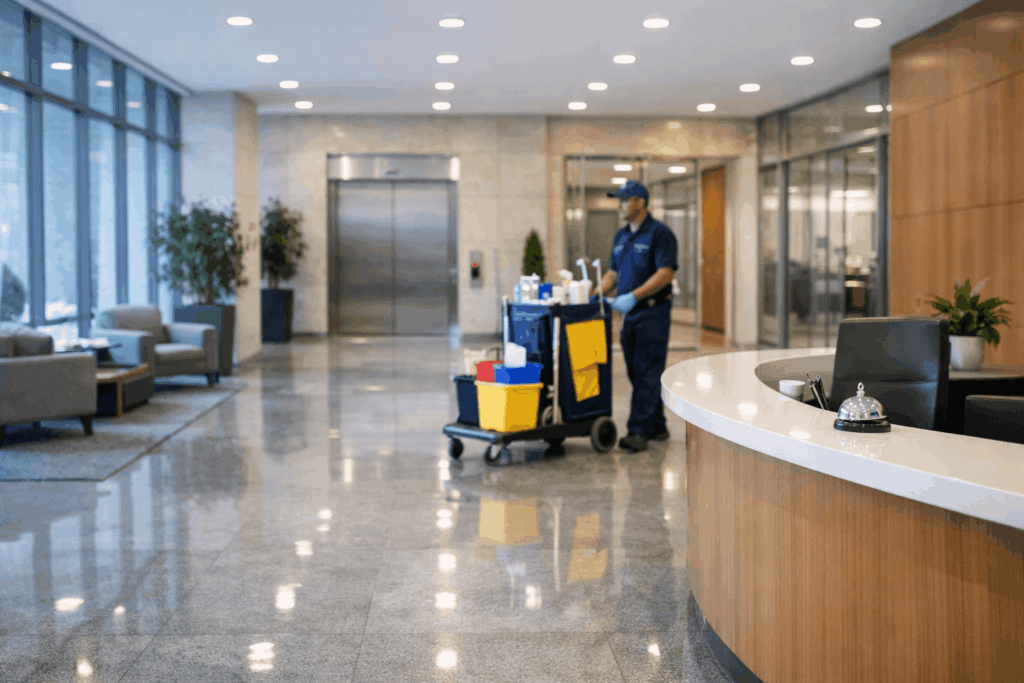
  • A day porter service during building hours catches problems in real time, before a tenant calls to complain
  • A spill in the lobby at 10am that is not addressed until the next morning cleaning is a lease-renewal conversation you do not want to have
Layer 2 — Tenant Suite Scheduled Janitorial

Nightly or 2x Week

  • This is the nightly or twice-weekly periodic janitorial serviceins inside individual office spaces
  • Frequency is set per suite based on actual occupancy and use, not per floor
  • A four-person law office needs different service than a 40-person open-plan marketing team on the same floor
  • Set the scope in writing per suite, or the crew defaults to the average and both high-use and low-use spaces get the wrong service
Layer 3 — Building-Wide Periodic Deep Cleaning
Quarterly or Seasonal
  • Quarterly or seasonal service covering commercial carpet extraction, exterior window washing, HVAC grille cleaning
  • Parking lot pressure washing, hard floor stripping and refinishing where needed, and restroom grout treatment
  • This is the layer most property managers underinvest in. It is also the layer responsible for the cumulative buildup that causes odor, premature surface deterioration, and the kind of condition report that triggers disputes at lease renewal

Document everything in writing. The most common dispute between property managers and cleaning vendors comes from verbal agreements about who covers which areas. Every layer above should be written into the contract scope with specific task lists, frequencies, and sign-off requirements. Vague scope is where quality gaps hide.

Daily, Weekly, and Monthly Cleaning Tasks: What Goes Into Each?

Most property managers have a general sense of what a commercial cleaning schedule looks like. What most vendor contracts lack is the task-level specificity that separates a building that looks clean from one that actually is clean. Here is what each tier covers and what is typically missing from underpowered contracts.

How Does Foot Traffic Affect Your Cleaning Frequency?

Foot traffic is the most reliable predictor of how fast a building accumulates contamination. A building cleaning frequency model that does not account for actual usage patterns will always produce the wrong schedule, either over-cleaning low-use areas or, more commonly, under-cleaning the zones that matter most.

Foot Traffic Thresholds and Required Response
100+ / day
Daily nightly service
300+ / day
+ Day porter
500+ / day
+ Mid-day checks

In most Denver commercial buildings, the 300+ threshold applies to the main lobby, elevator banks in buildings over four floors, restrooms on primary tenant floors, and any break room or food-service area serving the whole floor.

Daily Tasks

Every Business Day

  • Quarterly or seasonal service covering commercial carpet extraction, exterior window washing, HVAC grille cleaning
  • Parking lot pressure washing, hard floor stripping and refinishing where needed, and restroom grout treatment
  • This is the layer most property managers underinvest in. It is also the layer responsible for the cumulative buildup that causes odor, premature surface deterioration, and the kind of condition report that triggers disputes at lease renewal
Weekly Tasks

Once or Twice Per Week

  • Full vacuum of all carpeted areas in tenant suites
  • Dust all horizontal surfaces including desks, shelves, filing cabinet tops, and windowsills
  • Clean interior glass partitions and suite-level windows
  • Sanitize break room appliances, countertops, sink basins, and backsplash
  • Mop hard-surface floors in kitchens, restrooms, and service corridors with a disinfectant solution
  • Wipe down baseboards in high-traffic corridors
  • Clean and rotate entry mats where possible
Monthly Tasks

Once Per Month

  • Detail clean behind and underneath all office furniture
  • Wash light fixture covers and HVAC return grilles
  • Deep clean break room appliance interiors: refrigerators, microwaves, toaster ovens
  • Strip and refinish hard floors in common areas as wear dictates
  • Inspect restroom grout lines and treat any discoloration or mold growth
 
Quarterly Deep Cleaning

Every 3 Months or Seasonally

  • Commercial carpet hot-water extraction  throughout the building — not surface shampooing, which redeposits soil back into fibres
  • Full window washing including building exterior panes
  • Power washing of building facade, parking surfaces, and loading dock areas
  • HVAC vent and grille cleaning across all floor levels
  • Full restroom tile and grout treatment
  • Detailed cleaning of all upholstered seating in common areas

On carpet and floor maintenance specifically: commercial carpet manufacturers recommend hot-water extraction every 3 to 6 months in standard office environments. In Colorado’s dry, high-altitude climate, erring toward every 3 months in entry zones and high-traffic corridors is the right call. Surface-only vacuuming without extraction allows fine particulate to compress into fibre, which degrades the pile, shortens carpet life, and contributes directly to the odor problem described at the top of this article.

Top Signs a Commercial Cleaning Company Is Not Doing a Good Job

Having a cleaning contract does not mean your building is actually clean. The gap between what is in the contract and what is being delivered is where most property manager headaches originate. Here are the specific signals that tell you your current commercial cleaning service has a quality problem, before it becomes a tenant complaint or a lease non-renewal.

Building smells within 24 hours of a cleaning visit
This means surface-only cleaning. The odor sources (carpet moisture, drain traps, grout, HVAC) are not being addressed. This is a scope problem, not a crew problem.
1
Restrooms need attention by mid-morning
Either the nightly scope is insufficient for your actual occupancy, the disinfectants being used are not commercial-grade, or the restroom cleaning is being rushed. Mid-day restroom checks, managed through a day porter, solve this in high-occupancy buildings.
2
Carpet looks clean but feels gritty or compressed underfoot
Vacuuming is happening but extraction is not. Fine particulate has compressed into the pile. This accelerates fibre breakdown and creates the base for persistent odor. If you cannot remember the last time carpet was hot-water extracted, that is your answer.
3
You discover problems rather than being told about them
A professional cleaning crew documents what was done, notes anything unusual (water under a mat, a broken fixture, a stain that did not come out), and communicates it before you find it. If you are making discoveries, accountability is absent from the relationship.
4
Entry mats are permanently grey or compressed
Entry mats that are not rotated, extracted periodically, and replaced on a defined schedule trap rather than prevent contamination from entering the building. They become a source rather than a solution.
5
The contract scope never changes even when your building does
If you have added tenants, changed building hours, or increased occupancy in the last 12 months and the cleaning scope has not been reviewed, you are running the wrong program. A vendor that does not proactively flag this is executing a static contract, not managing your facility.
6

If three or more of these apply, the problem is systemic, not individual. Switching vendors without fixing the scope first produces the same result with a different company name on the invoice.

How Fast Can CFS Start Service for a Denver Building?

CFS has been maintaining commercial properties across Denver and Colorado for over 25 years, including office buildings, corporate campuses, industrial facilities, logistics properties, and multi-tenant commercial parks across the Front Range.

The setup process for a new building takes 3 to 5 business days from site walkthrough to first service date. During the walkthrough, we document every area of your facility, map foot traffic patterns by zone, flag any existing maintenance concerns, and build a custom cleaning schedule matched to how your building actually operates. Nothing is templated from a previous account. Every schedule is built around your tenants, your hours, your surface types, and your building’s current condition.

For commercial buildings in Denver, Aurora, Broomfield, Colorado Springs, and Boulder, we provide a dedicated account contact, regular quality inspections, and direct communication. If something is missed between scheduled visits, you have one number to call and a crew that already knows the building.

1
Site Walkthrough
We document every area, map foot traffic by zone, and flag existing maintenance concerns. No assumptions, no templates from previous accounts.
2
Custom Schedule Built
Your program is built around your tenants, hours, surface types, and building's current condition. Completed days 1 to 2.
3
Contract Scoped in Writing
Every task, every frequency, every zone documented and signed. No verbal agreements that create disputes later.
4
First Service Date
First crew on-site within 3 to 5 business days of walkthrough. Dedicated account manager from day one.

Have a Question?
We're Here to Help.

Our team is here to help. Reach out and we’ll be happy to assist you.

Frequently Asked Questions

How often should office carpet be professionally extracted in a Colorado commercial building?

Commercial carpet in Colorado office buildings should be hot-water extracted every 3 to 6 months. Entry zones, main corridors, and meeting rooms used by multiple people daily need extraction every 3 months. Private offices with light use can extend to 6 months. Colorado’s dry climate and dusty air mean fine particles penetrate carpet fibres faster than in more humid regions, and surface vacuuming alone does not address the compressed particulate that degrades fibre and causes odor. Most commercial carpet manufacturer warranties also require documented professional cleaning on a set schedule to remain valid.

Regular janitorial service maintains surface-level cleanliness on a consistent schedule: vacuuming, bin removal, restroom sanitization, surface wiping, and basic glass cleaning. A commercial deep clean addresses what regular service does not reach: carpet extraction, HVAC vent and grille cleaning, restroom grout treatment, appliance interiors, furniture underneath, and exterior power washing. Deep cleaning is scheduled every 4 to 12 weeks depending on building type, sitting on top of regular janitorial service, not replacing it. Buildings that run deep cleaning as their only cleaning rather than as a supplement deteriorate faster because the daily accumulation is never controlled.

Yes, and for most property managers this is the better setup. A single vendor with full-service scope means consistent communication, one contract to manage, and a crew that already knows your building layout, surface types, and tenant sensitivities. CFS provides both periodic janitorial service and full-facility deep cleaning under a unified service agreement for commercial buildings across Colorado.
Occupancy is the most direct driver of cleaning frequency. A fully occupied 30,000 sq ft building with 150 employees generates more waste, restroom usage, and surface contamination than the same building at 60% occupancy. The right approach is to baseline your cleaning schedule on peak occupancy, then review the scope annually. Buildings that stay on a schedule written for their previous occupancy level, whether higher or lower, consistently have either overspent or under-serviced cleaning programs.
After-hours janitorial handles the bulk of the work: full vacuuming, restroom cleaning, bin removal, floor mopping, and surface wiping. During-hours tasks handled by a day porter cover what accumulates throughout the business day: restroom touch-up service, lobby floor spot cleaning after rain or snow, spill response, break room restocking, and visible mess in common areas. Buildings over 30,000 sq ft or with high visitor traffic almost always benefit from both. Buildings under 15,000 sq ft with moderate occupancy typically run well on after-hours service alone.
CFS
Commercial Facility Services

CFS provides comprehensive facility services across Colorado and 8 additional states, including janitorial, building maintenance, day porter, carpet and floor reconditioning, exterior maintenance, and 24-hour emergency response. Over 210 active accounts managed from Broomfield, CO headquarters.

In This Article

Have a Question?
We're Here to Help.

Our team is here to help. Reach out and we’ll be happy to assist you.

Related Articles
How to Remove Vagrants From Commercial Property in Colorado: Legal Steps, Safety, and Cleanup
How to Find a Reliable Commercial Cleaning Company in Boulder, Colorado (2026 Vetting Checklist)
Commercial Water Damage: What to Do in the First 24 Hours (Complete Property Manager Guide)
Managing Facility Cleaning Across Multiple Locations: The Single-Vendor Playbook for Operations Directors
Commercial Graffiti Removal: How to Clean Any Surface Without Causing Permanent Damage

How Often Should a Commercial Building Be Deep Cleaned? Complete Guide for Denver and Colorado

Property managers across Colorado ask this constantly. Here is the frequency breakdown by building type, a task-by-task schedule, and the warning signs your cleaning vendor is falling short.

Most commercial buildings in Denver and across Colorado need a deep clean every 4 to 12 weeks, layered on top of regular nightly or weekly janitorial service. The exact interval depends on four things: building type, daily occupancy, industry requirements, and Colorado-specific seasonal conditions that most generic cleaning guides ignore entirely.

This guide gives facility managers and property managers a precise, practical framework. Not a one-size-fits-all answer, but a system you can apply to your specific building, adjust by zone, and use to hold your cleaning vendor accountable. After 25 years of maintaining commercial properties from Broomfield to Colorado Springs, we have seen what works and what costs building owners in unnecessary repairs, tenant complaints, and early surface replacement.

Why Does My Office Building Smell Musty Even After Regular Cleaning?

This is the most common complaint we hear from property managers who already have a cleaning contract in place. The building gets cleaned. The crew shows up. And it still smells.

The reason is almost always the same: standard janitorial service cleans surfaces, not sources. Vacuuming picks up what is on top of carpet. Restroom service wipes what is visible. Break room cleaning hits the counter. None of that touches the organic buildup that causes persistent odor: moisture trapped under entry mat backing, bacteria in restroom grout lines that a mop passes over rather than into, food residue inside drain traps, and particulate matter that has settled into carpet fibres over months without extraction.

Denver’s climate makes this worse than it is in most U.S. cities. At 5,280 feet with low annual humidity, fine dust particles stay airborne longer and travel further through HVAC systems before settling. They accumulate in vent grilles, on top of ceiling tiles, inside return air ducts. When air circulates through a system that has not been cleaned, it picks up that particulate and distributes it across the building. That is the base note of the musty smell most property managers cannot locate.

Colorado winters add a second layer. Road salt and deicing chemicals tracked in from parking lots bond to carpet fibres at entry points. If those areas are vacuumed but not extracted, the salt residue holds moisture. That moisture is what creates the stale, damp odor that shows up within 24 hours of a cleaning visit.

If your building smells within 24 hours of a cleaning visit, the problem is not how often you clean. It is how deep.

The fix: A periodic janitorial service program that layers scheduled deep cleaning on top of nightly service addresses the actual sources, not just the visible surfaces.

How Often Should a Commercial Building Be Deep Cleaned in Denver?

The short answer for most commercial buildings in Denver: a full deep clean every 6 to 8 weeks, with high-traffic zones handled more frequently. Here is how that breaks down by building type and use.

Colorado seasonal adjustments that no generic national guide covers:

November through February — Winter

Schedule a mid-season deep clean of all entry zones, lobby carpet, and restrooms. Road salt and slush tracked in from Denver's parking lots bond to surfaces and create bacteria-holding moisture if not extracted before February.

March and April — Spring Thaw

Power wash building exterior, parking lot surfaces, and loading dock areas. A full winter's worth of salt, sand, and debris accumulates on exterior concrete and brick over these months.

July through September — Dry Summer

HVAC vent cleaning becomes critical. Denver's dry heat keeps dust suspended in the air, and it moves through building ventilation more aggressively than in humid climates. Vent surfaces accumulate particulate that standard cleaning does not address.

How to Set Up a Cleaning Schedule for a Building With Multiple Tenants

Multi-tenant buildings are where commercial cleaning schedules become complicated. You have common areas that belong to everyone, private suites that each tenant controls under their lease, and shared infrastructure (restrooms, elevators, lobbies, stairwells) that falls entirely to building management. The mistake most property managers make is treating all of these the same way.

The structure that works across most property types is a three-layer model. Each layer has a different vendor scope, different frequency, and different budget allocation.

The structure that works across most property types is a three-layer model. Each layer has a different vendor scope, different frequency, and different budget allocation.

Layer 1 — Common Area Daily Coverage
Every Business Day
  • Lobby floors, elevator interiors, shared restrooms, stairwells, and break rooms used by multiple tenants
  • A day porter service during building hours catches problems in real time, before a tenant calls to complain
  • A spill in the lobby at 10am that is not addressed until the next morning cleaning is a lease-renewal conversation you do not want to have
Layer 2 — Tenant Suite Scheduled Janitorial

Nightly or 2x Week

  • This is the nightly or twice-weekly periodic janitorial serviceins inside individual office spaces
  • Frequency is set per suite based on actual occupancy and use, not per floor
  • A four-person law office needs different service than a 40-person open-plan marketing team on the same floor
  • Set the scope in writing per suite, or the crew defaults to the average and both high-use and low-use spaces get the wrong service
Layer 3 — Building-Wide Periodic Deep Cleaning
Quarterly or Seasonal
  • Quarterly or seasonal service covering commercial carpet extraction, exterior window washing, HVAC grille cleaning
  • Parking lot pressure washing, hard floor stripping and refinishing where needed, and restroom grout treatment
  • This is the layer most property managers underinvest in. It is also the layer responsible for the cumulative buildup that causes odor, premature surface deterioration, and the kind of condition report that triggers disputes at lease renewal

Document everything in writing. The most common dispute between property managers and cleaning vendors comes from verbal agreements about who covers which areas. Every layer above should be written into the contract scope with specific task lists, frequencies, and sign-off requirements. Vague scope is where quality gaps hide.

Daily, Weekly, and Monthly Cleaning Tasks: What Goes Into Each?

Most property managers have a general sense of what a commercial cleaning schedule looks like. What most vendor contracts lack is the task-level specificity that separates a building that looks clean from one that actually is clean. Here is what each tier covers and what is typically missing from underpowered contracts.

How Does Foot Traffic Affect Your Cleaning Frequency?

Foot traffic is the most reliable predictor of how fast a building accumulates contamination. A building cleaning frequency model that does not account for actual usage patterns will always produce the wrong schedule, either over-cleaning low-use areas or, more commonly, under-cleaning the zones that matter most.

Foot Traffic Thresholds and Required Response
100+ / day
Daily nightly service
300+ / day
+ Day porter
500+ / day
+ Mid-day checks

In most Denver commercial buildings, the 300+ threshold applies to the main lobby, elevator banks in buildings over four floors, restrooms on primary tenant floors, and any break room or food-service area serving the whole floor.

Daily Tasks

Every Business Day

  • Quarterly or seasonal service covering commercial carpet extraction, exterior window washing, HVAC grille cleaning
  • Parking lot pressure washing, hard floor stripping and refinishing where needed, and restroom grout treatment
  • This is the layer most property managers underinvest in. It is also the layer responsible for the cumulative buildup that causes odor, premature surface deterioration, and the kind of condition report that triggers disputes at lease renewal
Weekly Tasks

Once or Twice Per Week

  • Full vacuum of all carpeted areas in tenant suites
  • Dust all horizontal surfaces including desks, shelves, filing cabinet tops, and windowsills
  • Clean interior glass partitions and suite-level windows
  • Sanitize break room appliances, countertops, sink basins, and backsplash
  • Mop hard-surface floors in kitchens, restrooms, and service corridors with a disinfectant solution
  • Wipe down baseboards in high-traffic corridors
  • Clean and rotate entry mats where possible
Monthly Tasks

Once Per Month

  • Detail clean behind and underneath all office furniture
  • Wash light fixture covers and HVAC return grilles
  • Deep clean break room appliance interiors: refrigerators, microwaves, toaster ovens
  • Strip and refinish hard floors in common areas as wear dictates
  • Inspect restroom grout lines and treat any discoloration or mold growth
 
Quarterly Deep Cleaning

Every 3 Months or Seasonally

  • Commercial carpet hot-water extraction  throughout the building — not surface shampooing, which redeposits soil back into fibres
  • Full window washing including building exterior panes
  • Power washing of building facade, parking surfaces, and loading dock areas
  • HVAC vent and grille cleaning across all floor levels
  • Full restroom tile and grout treatment
  • Detailed cleaning of all upholstered seating in common areas

On carpet and floor maintenance specifically: commercial carpet manufacturers recommend hot-water extraction every 3 to 6 months in standard office environments. In Colorado’s dry, high-altitude climate, erring toward every 3 months in entry zones and high-traffic corridors is the right call. Surface-only vacuuming without extraction allows fine particulate to compress into fibre, which degrades the pile, shortens carpet life, and contributes directly to the odor problem described at the top of this article.

Top Signs a Commercial Cleaning Company Is Not Doing a Good Job

Having a cleaning contract does not mean your building is actually clean. The gap between what is in the contract and what is being delivered is where most property manager headaches originate. Here are the specific signals that tell you your current commercial cleaning service has a quality problem, before it becomes a tenant complaint or a lease non-renewal.

Building smells within 24 hours of a cleaning visit
This means surface-only cleaning. The odor sources (carpet moisture, drain traps, grout, HVAC) are not being addressed. This is a scope problem, not a crew problem.
1
Restrooms need attention by mid-morning
Either the nightly scope is insufficient for your actual occupancy, the disinfectants being used are not commercial-grade, or the restroom cleaning is being rushed. Mid-day restroom checks, managed through a day porter, solve this in high-occupancy buildings.
2
Carpet looks clean but feels gritty or compressed underfoot
Vacuuming is happening but extraction is not. Fine particulate has compressed into the pile. This accelerates fibre breakdown and creates the base for persistent odor. If you cannot remember the last time carpet was hot-water extracted, that is your answer.
3
You discover problems rather than being told about them
A professional cleaning crew documents what was done, notes anything unusual (water under a mat, a broken fixture, a stain that did not come out), and communicates it before you find it. If you are making discoveries, accountability is absent from the relationship.
4
Entry mats are permanently grey or compressed
Entry mats that are not rotated, extracted periodically, and replaced on a defined schedule trap rather than prevent contamination from entering the building. They become a source rather than a solution.
5
The contract scope never changes even when your building does
If you have added tenants, changed building hours, or increased occupancy in the last 12 months and the cleaning scope has not been reviewed, you are running the wrong program. A vendor that does not proactively flag this is executing a static contract, not managing your facility.
6

If three or more of these apply, the problem is systemic, not individual. Switching vendors without fixing the scope first produces the same result with a different company name on the invoice.

How Fast Can CFS Start Service for a Denver Building?

CFS has been maintaining commercial properties across Denver and Colorado for over 25 years, including office buildings, corporate campuses, industrial facilities, logistics properties, and multi-tenant commercial parks across the Front Range.

The setup process for a new building takes 3 to 5 business days from site walkthrough to first service date. During the walkthrough, we document every area of your facility, map foot traffic patterns by zone, flag any existing maintenance concerns, and build a custom cleaning schedule matched to how your building actually operates. Nothing is templated from a previous account. Every schedule is built around your tenants, your hours, your surface types, and your building’s current condition.

For commercial buildings in Denver, Aurora, Broomfield, Colorado Springs, and Boulder, we provide a dedicated account contact, regular quality inspections, and direct communication. If something is missed between scheduled visits, you have one number to call and a crew that already knows the building.

1
Site Walkthrough
We document every area, map foot traffic by zone, and flag existing maintenance concerns. No assumptions, no templates from previous accounts.
2
Custom Schedule Built
Your program is built around your tenants, hours, surface types, and building's current condition. Completed days 1 to 2.
3
Contract Scoped in Writing
Every task, every frequency, every zone documented and signed. No verbal agreements that create disputes later.
4
First Service Date
First crew on-site within 3 to 5 business days of walkthrough. Dedicated account manager from day one.

Have a Question?
We're Here to Help.

Our team is here to help. Reach out and we’ll be happy to assist you.

Frequently Asked Questions

How often should office carpet be professionally extracted in a Colorado commercial building?

Commercial carpet in Colorado office buildings should be hot-water extracted every 3 to 6 months. Entry zones, main corridors, and meeting rooms used by multiple people daily need extraction every 3 months. Private offices with light use can extend to 6 months. Colorado’s dry climate and dusty air mean fine particles penetrate carpet fibres faster than in more humid regions, and surface vacuuming alone does not address the compressed particulate that degrades fibre and causes odor. Most commercial carpet manufacturer warranties also require documented professional cleaning on a set schedule to remain valid.

Regular janitorial service maintains surface-level cleanliness on a consistent schedule: vacuuming, bin removal, restroom sanitization, surface wiping, and basic glass cleaning. A commercial deep clean addresses what regular service does not reach: carpet extraction, HVAC vent and grille cleaning, restroom grout treatment, appliance interiors, furniture underneath, and exterior power washing. Deep cleaning is scheduled every 4 to 12 weeks depending on building type, sitting on top of regular janitorial service, not replacing it. Buildings that run deep cleaning as their only cleaning rather than as a supplement deteriorate faster because the daily accumulation is never controlled.

Yes, and for most property managers this is the better setup. A single vendor with full-service scope means consistent communication, one contract to manage, and a crew that already knows your building layout, surface types, and tenant sensitivities. CFS provides both periodic janitorial service and full-facility deep cleaning under a unified service agreement for commercial buildings across Colorado.
Occupancy is the most direct driver of cleaning frequency. A fully occupied 30,000 sq ft building with 150 employees generates more waste, restroom usage, and surface contamination than the same building at 60% occupancy. The right approach is to baseline your cleaning schedule on peak occupancy, then review the scope annually. Buildings that stay on a schedule written for their previous occupancy level, whether higher or lower, consistently have either overspent or under-serviced cleaning programs.
After-hours janitorial handles the bulk of the work: full vacuuming, restroom cleaning, bin removal, floor mopping, and surface wiping. During-hours tasks handled by a day porter cover what accumulates throughout the business day: restroom touch-up service, lobby floor spot cleaning after rain or snow, spill response, break room restocking, and visible mess in common areas. Buildings over 30,000 sq ft or with high visitor traffic almost always benefit from both. Buildings under 15,000 sq ft with moderate occupancy typically run well on after-hours service alone.
CFS
Commercial Facility Services

CFS provides comprehensive facility services across Colorado and 8 additional states, including janitorial, building maintenance, day porter, carpet and floor reconditioning, exterior maintenance, and 24-hour emergency response. Over 210 active accounts managed from Broomfield, CO headquarters.

In This Article

Have a Question?
We're Here to Help.

Our team is here to help. Reach out and we’ll be happy to assist you.

Related Articles
How to Remove Vagrants From Commercial Property in Colorado: Legal Steps, Safety, and Cleanup
How to Find a Reliable Commercial Cleaning Company in Boulder, Colorado (2026 Vetting Checklist)
Commercial Water Damage: What to Do in the First 24 Hours (Complete Property Manager Guide)
Managing Facility Cleaning Across Multiple Locations: The Single-Vendor Playbook for Operations Directors
Commercial Graffiti Removal: How to Clean Any Surface Without Causing Permanent Damage
Share This :